
The importance of tikanga Māori in Aotearoa’s legal system
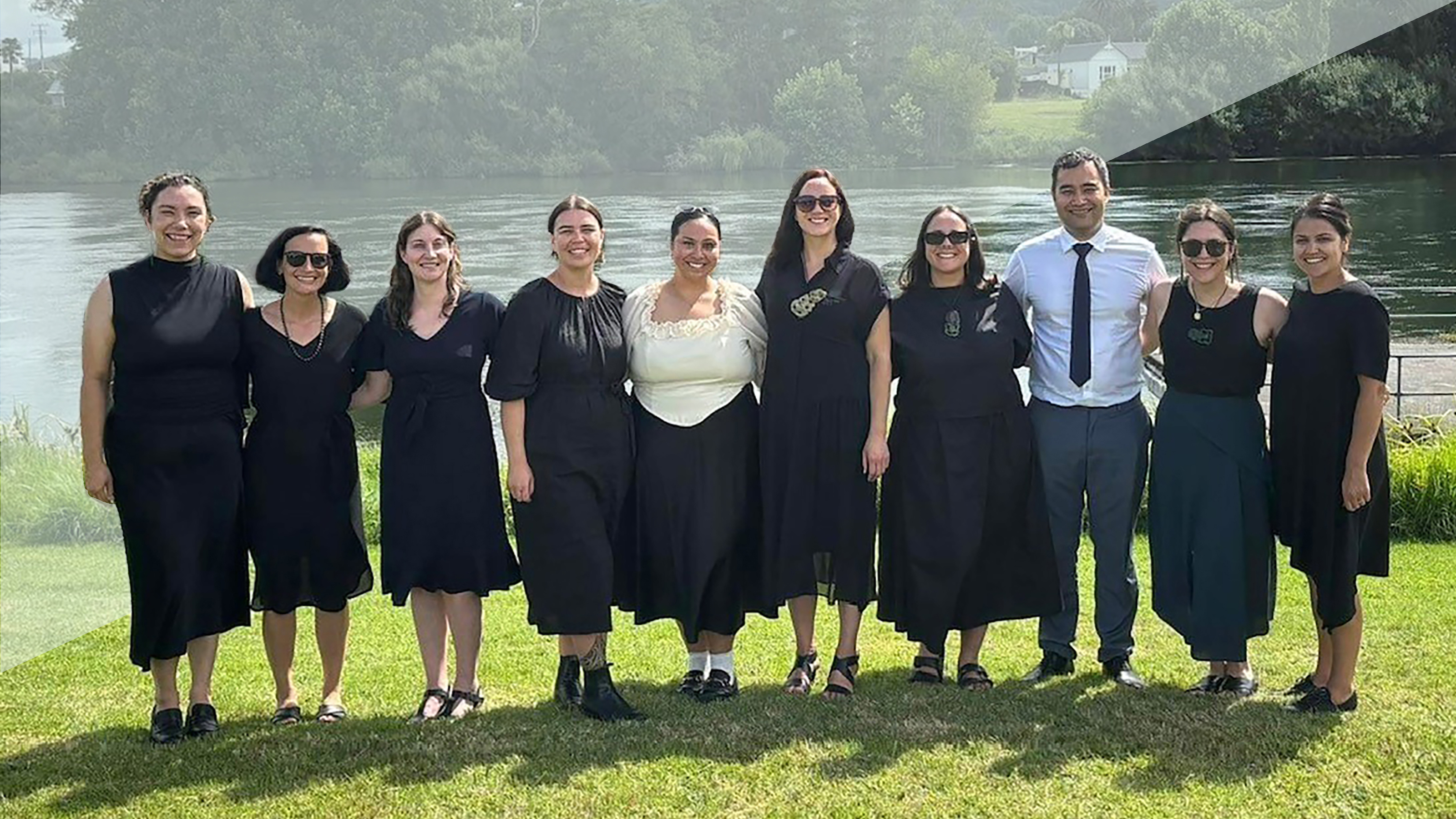
Horiana Irwin-Easthope (Ngāti Porou, Ngāti Kahungunu and Rakaipaaka), founder of Māori law firm Whāia Legal, is teaching LAWS 313—Ngā Tikanga Ture Māori (Māori Law) at Te Kauhanganui Tātai Ture—the Faculty of Law along with her friend and Whāia Legal co-director Tai Ahu (Waikato-Tainui, Ngāti Kahu [Te Paatu]). Both believe it’s more important than ever for students to learn about Māori legal concepts and practices.
The pair’s friendship blossomed after they crossed paths studying law and Māori language at Te Herenga Waka in the mid-2000s—they were both active members of Ngā Rangahautira, the Māori Law Students’ Association.
“Ngā Rangahautira was a really central part of my time at law school,” says Horiana. “I met people there who are now my very close friends and current partners at Whāia Legal. Those strong relationships are a real testament to the value of Ngā Rangahautira—law school can be quite an unfriendly environment for a lot of Māori students, so having a space to come together and support one another was really important.”
Horiana says in her first year at law school she got a front row seat to the real impacts the law can have on Māori.
“My first year—2004—was when the Foreshore and Seabed Act hīkoi took place, so we were literally across the road when it arrived on parliament grounds. In that moment, the reality of the effects of the law and those that wield power was on full display.”
After graduating with conjoint law and arts degrees (her BA majored in Māori resource management), Horiana worked at Russell McVeigh and boutique Māori law firm Kāhui Legal, before heading to the United States to do her Master of Laws at Harvard Law School. She then returned to Aotearoa and, after having her son, established Whāia Legal, with whānau, friend, and colleague Maia Wikaira joining in 2018.
Whāia Legal has a kaupapa Māori focus and works predominantly for Māori clients across different areas of law, with the aim of pushing the status quo to effect change. Whāia Legal currently has four partners, with offices in Wellington and Christchurch.
Tai and Horiana feel strongly about maintaining a connection to the law school and say it’s a privilege to work with the next generation of legal minds.
“I love the questions the students ask, their approach to work, and how smart they are. They are also strong in their tikanga and reo, which is awesome to see,” says Tai.
It’s amazing to work with students in this way—it’s important that we as practitioners keep in touch. These students will be the movers and shakers of our legal system, and it’s great that Māori thinking is at the forefront of the development of law.
Back when Horiana and Tai studied Māori customary law—taught then by Carwyn Jones—there were only about 15 students in the class. In 2024 that number has swelled to between 100 and 120. Horiana says the new requirement to teach tikanga as part of a law degree has obviously partly helped boost enrolments in LAWS 313, but the move hasn’t been without its detractors.
“It has been embraced by the majority of the profession and opposed by a loud few who believe there is no basis for tikanga as, or in, the law,” she says. “My approach is always to try to engage and understand the basis for differing views. Unfortunately, there are some people who hold those views who either refuse to be engaged or are unwilling to engage in debate grounded in reality. It will be an on-going process for the law school to navigate.”
Horiana also has serious concerns with the way in which the coalition agreements between the different political parties that make up the current Government—which are forming the basis of a number of actions the Crown is taking—are seemingly overriding Aotearoa’s constitutional arrangements.
To simply say, ‘well sorry, we’ve got a coalition agreement so we are just going to push ahead with this change,’ without considering the implications under Te Tiriti o Waitangi—or , for example, the Bill of Rights Act 1990—is fundamentally unconstitutional.
“The government—and the Crown, for the purposes of the Crown–Māori relationship—have a broad range of obligations. The implication of these actions is that agreements between three political parties are being held in higher regard than the Treaty of Waitangi—one of our constitutional founding documents. Something is wrong with that picture and should be of real concern to New Zealanders who care about the way power is exercised in our democracy,” she says.
However, Horiana and Tai and doing all they can to instil a sense of hope in up-and-coming young lawyers.
“I’m a big believer in hope—that’s what we’re striving to encourage, notwithstanding whatever else might be going on,” says Horiana. “The reality is that a number of young Māori people feel attacked and isolated by these policies and actions, so my focus is on reminding them that the law can be a tool to make a difference, whilst being realistic about the limitations of that tool. I have so much hope in what they’re capable of achieving, so I see my role as supporting them to do that.”

Te Kauhanganui Tātai Ture: Finding purpose through a shared community
This year, as always, my brilliant colleagues have produced world-leading research, taught over 2000 extraordinary students, and engaged widely to make Aotearoa and the world a better place. I know of no law school with fewer than 30 academic staff and as many students that manages such excellent teaching and research. Our equally amazing professional staff have done an extraordinary job in not just keeping things working but also making students’ lives just a little easier.
Our students are our future, and I tell them they are better versions of us—in some of the tough times this year, it is they who have helped us get through. I am constantly amazed at what our students get up to after they leave here, and just sometimes I like to claim a little bit of the credit that properly belongs to you!
But Tātai Ture is not just made up of those lucky enough to work or study here in the Old Government Buildings (OGB)—it is made up of all of you, wherever and whenever you get to read this.
We have decided to do V.Alum a bit differently so we can tell stories from within and from outside OGB. Please take a few minutes to read about our wonderful research, student leaders, and the achievements of some of our alumni.
The last couple of years have been unsettled for Te Herenga Waka, and I suspect that the next couple will be challenging for all our universities. The Law Faculty, however, has continued to be a thriving part of a university that is beginning to flourish again. We have five new academic staff who either have just started with us or will soon be here for us to nurture—emerging scholars in international trade, intellectual property, and comparative constitutional law; a leading mergers and acquisitions scholar from the US; and a new Professor of Public Health.
I am still getting used to working in the Dean’s office. Being Dean of the faculty that I have worked in for 30 years is a privilege and an honour but also, to be honest, a bit daunting. I have been amazed by all the goodwill and offers of help that I have received. I genuinely believe that despite the challenges 2025 will bring, we really can build an even better law school for our community. Priorities for next year include emphasising our links with the main University, joining with our friends across Bunny Street in Wellington School of Business and Government to create a unique Pipitea experience at the heart of our capital, emphasising the ‘place-based’ experience of learning law at VUW, and working to raise Pasifika achievement. Next year also is the first year of the new integrated tikanga curriculum that all students will study—we can’t wait to get started.
If we can do all this, it will be in no small part due to the tireless work of my predecessor, Lee Godden, who worked harder than any person I have ever known at the Law School. Lee had to return to Australia in August to care for whānau, but not before she had secured the funding for our new appointments.
It is summer, at least for those in Aotearoa. Just before Christmas, I will be in one of my happy places, Fiordland, walking the Kepler Track with my best man (whom I met in second-year law) and his family. On my to-do list are reading all the books that I missed out on during the year, fighting the ivy in our garden, and mostly just sitting in the sun—which is guaranteed this Wellington summer. I hope to finally make it in February to the top of Angelus Peak in Nelson Lakes. I also plan to catch up on some of my colleagues’ excellent research (really truly!)—you should too! Pick something from the list—it is all great.
One book I’m currently learning a lot from is Zest, written by my old torts student Daniel Kalderimis KC, who courageously writes about his recovery from depression, with the help of not only psychology but also philosophy. Daniel’s book is not so much about how to do law but is a lot about how we should choose to be more purposeful in those things that give us meaning. Daniel reminds me, though, that law is all about the narratives that connect people. Outside my family and friends, it has also been this university and our shared law community that have given me a sense of purpose and meaning. So I can’t wait for 2025.
Whiti te rā
Geoff