
Dhanika Ratnayake—“Robotics is a balancing act”
PhD graduate Dhanika Ratnayake spent his doctorate enhancing wheeled robot stability in rugged terrain, likening his field to “a balancing act where each element must harmonise perfectly to maintain stability.”
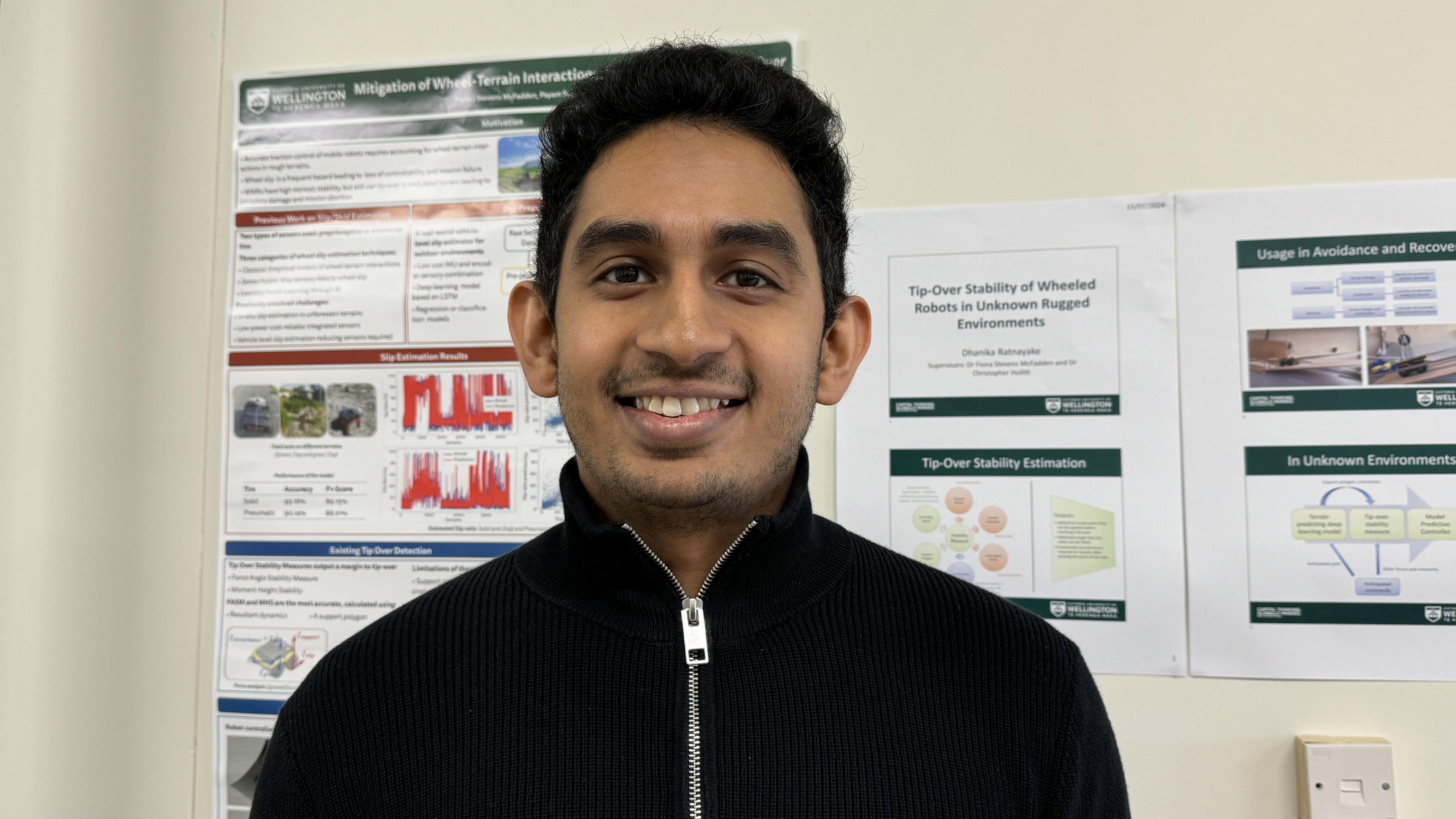
With a background marked by a deep interest in mechanical and mechatronics engineering, Dhanika's path to robotics was shaped by his familial legacy in academia and a keen interest in the rapidly evolving field of AI.
Growing up in Sri Lanka, Dhanika was inspired by his mother, a university lecturer in engineering, to pursue his passion for science. This foundational influence guided him to excel in engineering studies during high school in Sri Lanka and later at the Asian Institute of Technology (AIT) in Thailand. There he completed a rigorous programme in mechatronics engineering, propelling him towards a career that merges the intricate worlds of mechanical engineering, electronics and control engineering.
Dhanika's academic journey did not stop with his master's degree. His curiosity and desire to delve deeper into robotics led him to the Paihau—Robinson Research Institute, where he undertook a Doctor of Philosophy (PhD) under the supervision of Dr Fiona Stevens McFadden, Principal Engineer and Deputy Director at the institute, and Dr Christopher Hollitt of Te Kura Mātai Pūkaha, Pūrorohiko—School of Engineering and Computer Science. He completed his PhD in mid-2025.
His research, a study of the tip-over stability of wheeled robots in unknown rugged environments, aims to improve robotic stability and to open the way for safer, more reliable robotic operations in sectors such as search and rescue, agriculture and forestry.
Explaining the essence of his work, Dhanika says, “Robotics is like trying to dance on a tightrope where each step is uncertain but has to be perfectly calculated.” His thesis produced a new way of measuring how close a four-wheeled robot is to tipping—one that accounts for the dynamic forces the established measures miss, and that expresses the answer in terms a control system can act on in real time. Two models, one physics-based and one built on deep learning, allow the robot to work this out from its own internal sensors alone, without any prior knowledge of the ground beneath it.
At the Paihau—Robinson Research Institute, Dhanika worked in a collaborative environment where his research benefited from the connection between academic work and real-world application. Reflecting on his time at the institute, he notes, “The Paihau—Robinson Research Institute is an ideal place for PhD research. It has university-wide resources at your fingertips, international connections, and a wonderful culture with all the support you can wish for to become successful.”
His findings have added to academic knowledge and carry practical value in improving the operational capability and safety of robotic systems. Fitted to a robot, the control system he developed significantly reduced the number of tip-overs. Reflecting on the impact of his work, he says, “The aim is to design robots that can traverse unpredictable terrains with the same finesse as a mountain goat deftly scaling a rugged cliffside.”
Dhanika's journey from the classrooms of Sri Lanka to the rugged terrain explored by his robots exemplifies a dedication to pushing the boundaries of what autonomous systems can achieve. His story is one of academic achievement and of a commitment to making complex science relevant to everyday challenges.