
Nipuni Perera—Teaching robots self-reliant navigation
A robot can lose track of where it is without ever realising it has done so. Nipuni Perera's doctoral research set out to catch the moment it happens—in a forest, without a map, and without help from a satellite.
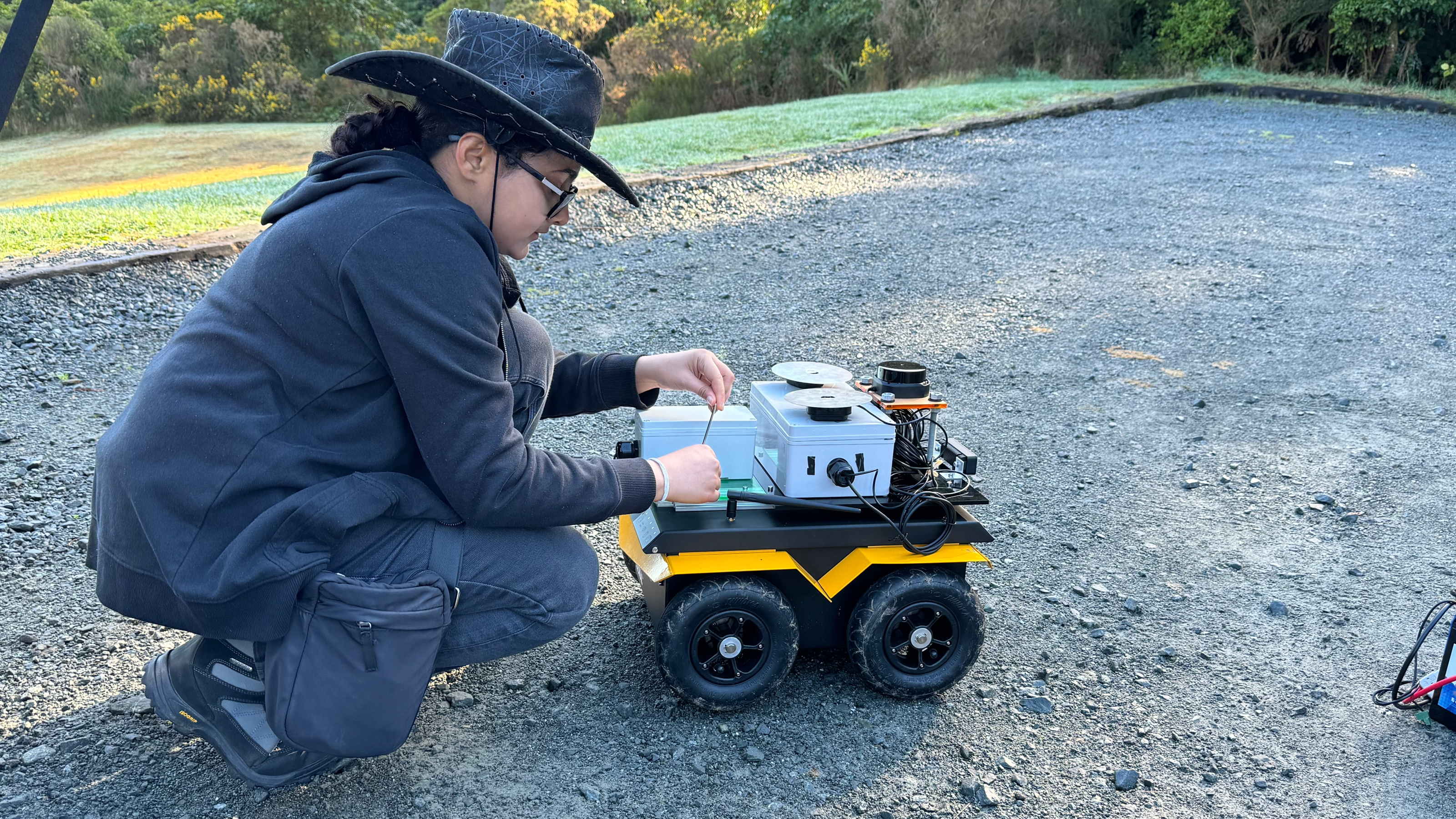
In July, Nipuni Perera successfully defended her PhD thesis, Kidnap detection and recovery for mobile robots in rugged forested environments, completing four years of research at the Paihau—Robinson Research Institute. She was supervised by Dr Fiona Stevens McFadden, Principal Engineer and Deputy Director at the institute, and Dr Christopher Hollitt of Te Kura Mātai Pūkaha, Pūrorohiko—School of Engineering and Computer Science.
The problem she set out to solve has a name in the field: the kidnapped robot problem. In its most extreme form, a robot is physically picked up and carried somewhere else while its software carries on believing it has not moved. But the same failure follows from far more ordinary events—a wheel slipping on a wet bank, a sensor faulting, or changes in an environment. In each case the robot's sense of its own position is wrong, and it does not know it.
Most robotics research assumes conditions that make this manageable: controlled indoor spaces, or structured outdoor sites such as substations and warehouse yards, where GPS is reliable and the surroundings are known in advance. Real-world applications demand more. “Imagine a robot navigating through a dense forest,” Nipuni explains. “Under the canopy, GPS signals are unreliable and can be blocked.”
Testing the literature against a real forest
Working with the institute's Clearpath Jackal platform, Nipuni began by testing a range of published detection methods—first in simulation, then against real-world data gathered in forests around the Wellington region, alongside data from the tidier environments the literature usually assumes.
The results were blunt. Many methods that performed well in simulation failed outright on the forest data. Others were unusable in the field because they demanded detailed prior knowledge of the environment, or were too slow to return an answer in time to be of any practical use.
“The methods in the literature assume you already know something about where you are,” she says. “In a forest you usually don't, and that assumption is exactly what breaks.”
She developed two new detection methods in response. Both rely only on lidar. Both need just two scans—one before the disruption and one after—to establish that something has gone wrong. Both classify events reliably, need minimal prior knowledge of the environment, and run at real-time rates on conventional hardware.
Knowing what to do next
Detection, though, is only half the problem. Knowing that something has changed does not tell a robot what has changed, and the right response to a sensor fault is quite different from the right response to being lifted and carried.
The thesis also developed a framework for working out the likely cause of a detection and acting on it. Events that genuinely destroy a robot's sense of position can be distinguished from those that do not—not with absolute certainty, but well enough that a robot can resume normal operation when its localisation was never truly lost. When it was, recovery is not always possible in an unknown environment. What the framework does offer in that case is enough knowledge of what happened to keep the robot out of danger.
Economic business and impact
The applications are substantial. Autonomous robots capable of working in diverse environments without frequent human intervention could reshape industries such as forestry management and disaster response.
In forestry, robots could monitor and maintain difficult terrain, improving safety and efficiency in a sector where slips, trips and falls are among the largest causes of lost-time injury. In disaster scenarios such as earthquakes or floods, adaptable robots could assist in search and rescue operations, reducing risk to human responders.
Having methods that require minimal prior knowledge matters commercially as much as scientifically. A method that works without a pre-built map is one that can be deployed in a forest block, a disaster zone, or a survey area no robot has visited before.
Nipuni's journey and passion
Nipuni's journey to the Paihau—Robinson Research Institute is as compelling as her research. “I’m from Colombo, a bustling city full of life in Sri Lanka. But I actually did my master’s studies in Thailand at the Asian Institute of Technology (AIT) before coming here,” she recalls.
Her interest in robotics was ignited during her master's project, which involved localisation in urban areas. She noticed significant problems when robots moved from open to obstructed environments. “This sparked my curiosity about how these systems could adapt to even more complex settings like forests or uneven terrains, where traditional GPS fails,” she explains.
Balancing science and creativity
Beyond her research, Nipuni finds solace and creativity in writing fantasy and science fiction. “Writing is a wonderful outlet for me; it allows me to create entire worlds and explore complex characters. It's challenging to balance with my research, but it's also a great way to unwind,” she shares. This blend of scientific rigour and creative exploration epitomises her holistic approach to problem-solving and innovation.
She continues to work at the institute while she considers her next step, with both research and industry roles in prospect. “Robotics is a growing field, and the opportunities are vast. I'm open to exploring roles in academia to continue research and teaching or stepping into the industry where I can apply my expertise to practical challenges.”
The best place to study and navigate to the future
Reflecting on her time at the institute, Nipuni points to the support and the welcoming, diverse culture.. “For anyone passionate about robotics and seeking a collaborative and innovative research environment, this is a wonderful place to be.”
Her work is a concrete step towards robots that can operate in the natural world without a map and without a satellite fix—and that know what to do when they lose their place.