

Teach our tamariki
Give our youngest children a great start in life and enjoy the excitement, creativity, and fun of working in early childhood education.
The Graduate Diploma of Teaching (Early Childhood Education) gives you the skills, knowledge, and confidence to be a great early childhood teacher. Gain practical experience in early childhood centres, where you’ll apply your university learning and build meaningful relationships with teachers and children.
You’ll learn how to guide children’s development through the framework of Te Whāriki, the New Zealand early childhood curriculum. Once you graduate, you’ll be ready to work in preschools, kindergartens, early childhood services, and Pacific Island language nests.
Who can study for this qualification
This qualification is open to students with a level 7 Bachelor’s degree (or equivalent) in any subject.
Over 1 year, you’ll gain a professionally recognised early childhood teaching education that will take you to the next step in your career.
If you don’t already have a Bachelor’s degree but are interested in teaching young children, the 3-year Bachelor of Teaching (Early Childhood Education) might be a better fit.
What you’ll learn
The GDipTchg(ECE) is an 11-month, full-time programme with 16 weeks based in early childhood centres.
The Graduate Diploma teaches Te Whāriki, the early childhood curriculum of Aotearoa New Zealand. You’ll help children learn to deal with their changing worlds and to become independent learners.
New Zealand teachers live the values of Te Tiriti o Waitangi and use te reo Māori in their teaching practice. During your studies, you’ll strengthen your knowledge of Te Tiriti o Waitangi partnership and practice using te reo Māori in everyday situations.
Once you graduate, you’ll be ready to work with young children, families, and staff in the community. You’ll be qualified to teach in early childhood centres throughout New Zealand and be eligible for provisional teacher certification with the Teaching Council of Aotearoa New Zealand.
How you’ll study
This is a full-time qualification—you cannot study for it part time. It is taught as a combination of in-person study and practical teaching experience. Your courses begins in February at the start of Ngā Mihi week.
All teaching is on campus. You also need to attend Ngā Mihi at the opening of the programme, and Wānanga at the end.
In-person coursework
Your in-person study courses are taught over two long trimesters between February and early December. You can expect to spend 40 to 50 hours studying each week.
You’ll need to attend two week-long block courses at the University in Wellington. These are held at the beginning and end of the programme.
You’ll be supported by an academic mentor and a professional learning community of your peers.
Practical teaching experience
You’ll gain practical experience with three professional practice placements that develop your skills and demonstrate how theory and practice interconnect in your development as a teacher.
These placements are delivered in three compulsory full-time blocks:
- a one-week block in early March
- a seven-week block in early May
- eight weeks starting in mid-August.
The Education Professional Practice and Partnerships Office arranges these placements for you.
LAT employment doesn’t count towards
your professional practice
Our Graduate Diploma in Teaching qualifications are not employment-based programmes for applicants holding a limited authority to teach (LAT) dispensation. So, if you have a LAT, your employment doesn’t count towards your professional practice requirements at the University.
Qualification support and advice
We can help you match your interests and career goals with the right course of study.
If you’re a new student, talk to a Future Student Adviser through our enquiry form.
If you’re already studying with us, talk to Tītoko—Student Success.
For the research portion of your study, you’ll need a supervisor to help guide your research. Your programme coordinator will work with you to find the right person.

Entry requirements
Entry requirements for domestic students
- Requirements for students who completed university in:
If you live in New Zealand and are a citizen or permanent resident of New Zealand or Australia, you're considered a domestic student.
Some citizens of the Cook Islands, Niue, and Tokelau may automatically hold New Zealand citizenship.
Diplomatic residents living in New Zealand are also regarded as domestic students.
Entry requirements information is not available for the selected country and qualification.
Qualification requirements
Excerpt from the regulations for the GDipTchg(ECE)
2. The course of study for the GDipTchg(ECE) shall comprise Tātaimarau 3: Ngā Torohanga—Modalities for understanding lifeworlds (TCHG 222), Tātaimarau 4: Ngā Toi—Exploring modes of creativity and expression (TCHG 225), Akopai: Professional Practice 1 (TCHG 315), Akopai: Professional Practice 2 (TCHG 316), Kia Ako: Approaches to Early Childhood curriculum, assessment, and planning (TCHG 385), Kia Tika – Being a Kaiako with Infants, Toddlers and their Whānau (TCHG 386), Kia Māori—Inclusive Teaching in Diverse Communities (TCHG 387), Kia Mataara—Intentional Pedagogies in Local Contexts (TCHG 388).
3. A candidate shall normally be enrolled for one calendar year and shall complete the requirements of the diploma within two years of first enrolling in it. The associate dean may extend this maximum period in special cases. A candidate who wishes to take a leave of absence from the programme requires the approval of the associate dean.
4. The associate dean may cancel the enrolment of a candidate whose progress is unsatisfactory.
5. Courses in the GDipTchg(ECE) Schedule are excepted from the Aegrotat Pass provisions in the Assessment Handbook. In the event that a candidate is prevented from completing such a course by one of the circumstances specified in the relevant section of the Assessment Handbook, the candidate will be granted an appropriate extension.
Future careers
The Graduate Diploma qualifies you to teach in early childhood centres and kindergartens across New Zealand.
Once you graduate, you’re eligible to register as a teacher and apply for a Provisional Practising Certificate with the Teaching Council of Aotearoa New Zealand.
More career information
Find out more about careers in early childhood education.
The government careers website, Tahatū, offers more information about jobs, salaries, and current opportunities.
Scholarships
You may be able to get a scholarship to help fund your studies.
We have postgraduate and doctoral scholarships available, as well as specialised scholarships for different groups and subject areas. If nothing fits right now, something may suit you later.
We encourage you to apply. It’s a straightforward process, and it could make a real difference.
TeachNZ scholarships
You can also apply for a TeachNZ Scholarship. These scholarships are awarded based on specific areas where teachers are needed.
Scholarships for teaching
-
This scholarship was established in 1997 from a bequest from the estate of Arnold Woodford Izard. The scholarship is offered to students enrolled in a Master's by thesis degree in any faculty at Te Herenga Waka–Victoria University of Wellington, with the exception of the Faculty of Humanities and Social Sciences. NZSM students are still eligible to apply. This scholarship is...
-
This scholarship is offered to women graduates intending to study at Victoria University of Wellington in a course leading to a higher degree, which includes research in some field related to the general purpose of teaching or promoting the knowledge of home or domestic science among the women of New Zealand (e.g. Sociology, Psychology, Education or Science).
-
This scholarship is for students undertaking or intending to undertake an Honours or Masters degree at Te Herenga Waka—Victoria University of Wellington in areas related to Peace Building or Peace Studies, Trust Building, Conflict Resolution, addressing Historical Injustice, Restorative Justice, Social Cohesion, Community building and promoting cross-cultural understanding, Change Making or Ethical Leadership.
Scholarships for international students
We're currently offering a NZ$10,000 VUW Postgraduate International Scholarship to all eligible international students enrolling in a Master’s degree or Postgraduate Diploma programme.
Your scholarship will be processed automatically when your programme application is accepted, and the amount will be deducted from your tuition fees.
TeachNZ scholarships
You can also apply for a TeachNZ Scholarship. These scholarships are awarded based on specific areas where teachers are needed.
Other scholarships
We also have postgraduate and doctoral scholarships available, as well as specialised scholarships for different groups and subject areas. If nothing fits right now, something may suit you later.
We encourage you to apply. It’s a straightforward process, and it could make a real difference.
Scholarships for teaching
-
This scholarship was established in 1997 from a bequest from the estate of Arnold Woodford Izard. The scholarship is offered to students enrolled in a Master's by thesis degree in any faculty at Te Herenga Waka–Victoria University of Wellington, with the exception of the Faculty of Humanities and Social Sciences. NZSM students are still eligible to apply. This scholarship is...
-
This scholarship is offered to women graduates intending to study at Victoria University of Wellington in a course leading to a higher degree, which includes research in some field related to the general purpose of teaching or promoting the knowledge of home or domestic science among the women of New Zealand (e.g. Sociology, Psychology, Education or Science).
-
This scholarship has been established by a gift from Autism New Zealand to further its mission to empower the autistic and wider autism communities. The scholarship is designed to support Education and Educational Psychology Master’s by thesis students to undertake research evaluating early support for Autistic children.
Join our postgraduate community
The Postgraduate Students’ Association provides a voice for you on campus and information on studying at Te Herenga Waka—Victoria University of Wellington.
Postgraduate Students’ Association
MAI ki Pōneke
MAI ki Pōneke are part of an international network of Māori and Indigenous postgraduate students. They provide advice, support, and information to Indigenous postgraduate students of all levels, as well as those thinking about enrolling.
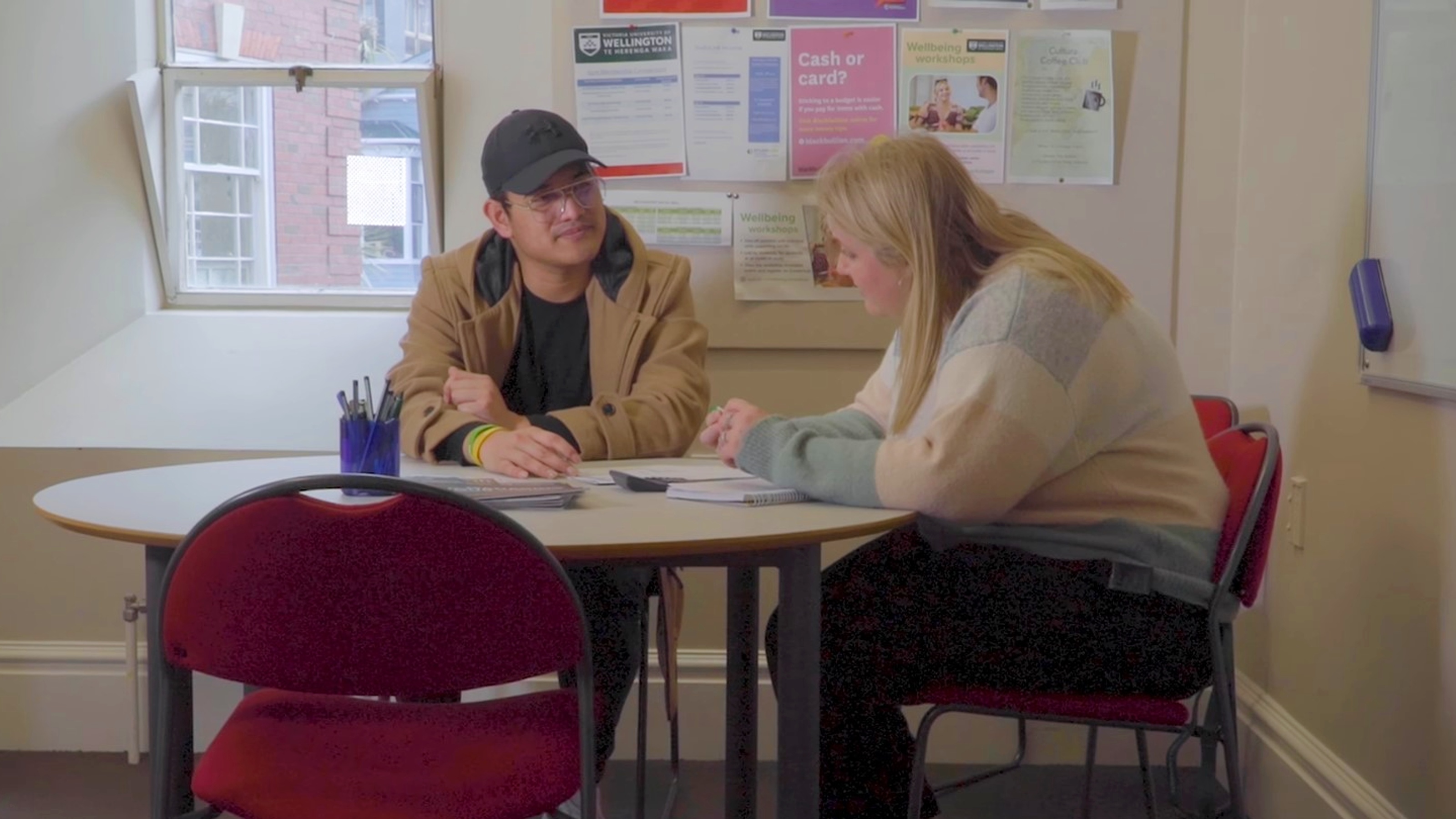
Get help to manage your finances
We can help you:
- budget your money
- manage your student loan or allowance
- work out your accommodation payment schedule.
If you’re facing financial difficulties, we can help you apply for the Hardship Fund.
You may be eligible for government or community support, too.
Apply for a New Zealand study visa
You’ll need to apply for a study visa if you plan to study with us as an international student.
You should apply for your visa after you’ve received your Offer of Place, and before you come to New Zealand.