

Qualify as a primary school teacher
Change the lives of Aotearoa New Zealand’s next generation. Gain the knowledge and practical skills to be a confident, effective primary school teacher.
The Graduate Diploma of Teaching (Primary) combines coursework with placements in the classroom to give you sound theoretical knowledge and practical teaching experience. You’ll develop your confidence, creativity, and communication skills to inspire New Zealand’s young people to learn and grow.
By taking this teaching qualification, you’re making a professional commitment to the teaching profession, to your future students, and to their whānau. You’ll graduate ready to teach in primary and intermediate schools throughout New Zealand and be qualified to register as a teacher with the Teaching Council of Aotearoa New Zealand.
Who can study for this qualification
The Graduate Diploma is open to anyone with a level 7 Bachelor's degree in any subject.
It’s a flexible qualification, so it’s a good option if you have responsibilities outside your studies. You can study online or on campus, and study part time as long as the programme director agrees.
You need to be competent in mathematics to enrol
You need to have skills in mathematics to enrol in initial teacher education (ITE) programmes in New Zealand.
In practice this means that before entry to the degree, you need to achieve a score of at least 690 on the Literacy and Numeracy for Adults Assessment Tool (LNAAT). We also recommend that you have NCEA Level 2 in mathematics, or equivalent. All students must do the LNAAT test even if they already have NCEA Level 2 mathematics.
This requirement is as per the Teaching Council’s mathematics/numeracy requirements.
Prepare for teacher education in your undergraduate degree
For entry to the GDipTchg(Primary), you need an undergraduate degree in any subject.
It’s useful to include courses in your undergraduate degree that will help prepare you for a teaching career—like te reo Māori and the history of Aotearoa New Zealand. You could also choose subjects you’d like to teach, or study areas that are relevant to learning, education, and child development.
The School of Education has more information about planning your undergraduate degree.
Read our guidance on choosing courses to do in your undergraduate degree.
What you’ll learn
In the GDipTchg(Primary), you’ll learn how and what to teach to primary school children. You’ll learn the theories and principles of assessment, teaching, and learning, and develop an understanding of the New Zealand Curriculum.
New Zealand teachers live the values of Te Tiriti o Waitangi and use te reo Māori in their teaching practice. During your studies, you’ll strengthen your knowledge of Te Tiriti o Waitangi partnership and practice by using te reo Māori in everyday and classroom situations.
Programme content
You’ll complete six mandatory courses in two areas: professional practice and primary learning design.
Your professional practice courses cover:
- education in the context of the Te Tiriti, tikanga Māori, and language-learning strategies to help you develop skills in te reo Māori
- models and frameworks for understanding and adapting to different contexts for learning
- developing an understanding of your professional responsibilities to education for Pacific peoples.
In your primary learning design courses, you:
- examine the nature and purposes of key learning areas of the New Zealand Curriculum, including the teaching of specialist areas like Mathematics and English
- create and present learning and teaching plans to develop your understanding of design for learning.
You’ll also study classroom management and developmental changes in children.
Specialise in Catholic school teaching
While studying for your Graduate Diploma of Teaching (Primary), you can also learn to teach the religious education curriculum that Catholic schools and some state-integrated schools follow.
The Te Kupenga Catholic Theological College offers a New Zealand Certificate in Christian Studies—Religious Education. This certificate is recognised by Catholic schools and other integrated schools throughout New Zealand that teach the religious education curriculum.
The Certificate includes a teaching experience in a Catholic school, and the College customises the delivery of the Certificate to your University timetable.
Find out more on the Te Kupenga Catholic Theological College website.
How you’ll study
The complete Graduate Diploma of Teaching (Primary) takes three trimesters of full-time study between February and November. You can expect to study for 40 to 50 hours each week, including 80 days of classroom instruction. The programme combines face-to-face and online teaching.
You can choose to complete the qualification:
- in 1 year of full-time study
- in up to 2 years of part-time study.
Gain practical teaching experience with teaching placements
The programme gives you practical classroom experience to gain skills in planning, teaching, analysis, communication, and presentation. You’ll develop your teaching skills, put your learning of teaching theory into practice, and learn to use te reo Māori in classroom situations.
You’ll complete one observation week and two teaching placements. The Education Professional Practice and Partnerships Office arranges these placements for you.
If you plan to study online, placements are usually arranged within your home region unless otherwise specified. If you live in a smaller town, you may need to travel to a nearby area where there are more school placement opportunities.
LAT work isn’t professional practice
If you hold a limited authority to teach (LAT), our Graduate Diploma in Teaching qualifications aren’t employment-based programmes for you. That means any teaching you do under your LAT doesn’t count towards your professional practice requirements with us.
Two pathways to primary teaching
We offer two pathways into primary school teaching in Aotearoa New Zealand: the Graduate Diploma in Teaching (Primary) and the Master of Teaching and Learning (Primary). Both include similar essential coursework and in-classroom experience, so either can qualify you to teach.
- Choose the Diploma if you want a pathway that balances theoretical foundations with practical preparation for becoming a qualified primary teacher.
- Choose the Master’s if you want a qualification that combines work-integrated learning with a deeper, more academic understanding of teaching and learning.
Both pathways provide a strong foundation for future research.
Qualification support and advice
We can help you match your interests and career goals with the right course of study.
If you’re a new student, talk to a Future Student Adviser through our enquiry form.
If you’re already studying with us, talk to Tītoko—Student Success.
For the research portion of your study, you’ll need a supervisor to help guide your research. Your programme coordinator will work with you to find the right person.

Entry requirements
Entry requirements for domestic students
- Requirements for students who completed secondary school in:
If you live in New Zealand and are a citizen or permanent resident of New Zealand or Australia, you're considered a domestic student.
Some citizens of the Cook Islands, Niue, and Tokelau may automatically hold New Zealand citizenship.
Diplomatic residents living in New Zealand are also regarded as domestic students.
To be accepted into this qualification, you need:
1. (a) Before enrolment, a candidate for the GDipTchg(Primary) shall have:
(i) completed a degree of a tertiary institution in New Zealand or an equivalent qualification from an overseas tertiary institution* and
(ii) demonstrated through the assessment exercise the qualities necessary for a satisfactory teacher; and
(iii) been accepted by the Associate Dean (Students) as a candidate for the diploma.
(b) Requirement (a)(i) may be waived by the associate dean for a candidate who has adequate training and experience to proceed with the proposed course of study.
*Candidates who have completed a degree at a tertiary institution outside New Zealand may be required to have their qualification assessed as equivalent to a New Zealand undergraduate degree by the New Zealand Qualifications Authority before entry into the programme.
More enrolment information
- Selection interviews take place in September, October, and November. We will contact you soon after you apply with options for interview dates.
- The selection meeting includes a literacy and numeracy test and an interview that evaluates your skills in listening, oral communication, how you interact with others, and your views about teaching and education. At the interview, you will introduce yourself with a mihi (greeting).
- If you have lived in a country other than New Zealand for 12 months or more within the past 10 years, you will need an overseas police clearance to enrol. The New Zealand Teaching Council has specific requirements for the overseas police clearance.
- If you want to enrol in this programme but don't meet some of the entry requirements, talk with the programme director or administrator to discuss your options.
- You're required to be of good character with the ability to meet the requirements of the Code of Professional Responsibility of the Teaching Council of Aotearoa New Zealand on graduation.
Qualification requirements
Excerpt from the regulations for the GDipTchg(Primary)
2. The course of study for the GDipTchg(Primary) shall comprise all the courses in the schedule.
3. A candidate shall normally be enrolled for one calendar year and shall complete the requirements of the diploma within two years of first enrolling in it. The associate dean may extend this maximum period in special cases. A candidate who wishes to take a leave of absence from the programme requires the approval of the associate dean.
4. The associate dean may cancel the enrolment of a candidate whose progress is unsatisfactory.
5. Courses in the GDipTchg(Primary) Schedule are excepted from the aegrotat pass provisions in the Assessment Handbook. In the event that a candidate is prevented from completing such a course by one of the circumstances specified in the relevant section of the Assessment Handbook, the candidate will be granted an extension to complete the assessment.
Why Wellington
The University’s local education networks place you with excellent schools and connect you to a strong professional community.
As the capital, Wellington also puts you close to national education agencies and policy organisations, giving you direct insight into educational leadership and policy in action.
Thanks to the city’s compact size, your placements, campus, and professional connections are all within easy reach—and that same network often leads to employment once you graduate.

Future careers
The Graduate Diploma of Teaching (Primary) makes you eligible for provisional teacher registration from the Teaching Council of Aotearoa New Zealand. Once you’re registered, you’ll be able to apply for teaching positions in New Zealand and overseas.
Teaching in New Zealand primary schools
Your employment prospects are good. New Zealand has a shortage of primary teachers, especially in rural areas, in schools with special language or cultural needs, or Māori‑medium schools. Teachers who speak te reo Māori are in higher demand.
Most primary teachers are employed in state or state‑integrated schools. There are also private schools, but those may have different hiring dynamics. A primary teacher qualification can lead to a career as a registered teacher in schools, Kura Kaupapa Māori, or alternative education providers.
If your previous academic qualification is from another country, you may need to have it assessed by the New Zealand Qualifications Authority after you graduate to help schools decide your salary.
More career information
Find out more about careers in teaching.
The government careers website, Tahatū, offers more information about jobs, salaries, and current opportunities.
Scholarships
You may be able to get a scholarship to help fund your studies.
We have postgraduate and doctoral scholarships available, as well as specialised scholarships for different groups and subject areas. If nothing fits right now, something may suit you later.
We encourage you to apply. It’s a straightforward process, and it could make a real difference.
Philippa and Morvyn Williams Scholarship
The Philippa and Morvyn Williams Scholarship is available to female postgraduate students of Māori descent.
TeachNZ scholarships
TeachNZ has scholarships to help you become a great teacher.
Scholarships for Teaching
-
The fund, which was established at the time of the renovation of the C3 lecture theatre, is to assist a second-year student from any faculty in their studies at Te Herenga Waka—Victoria University of Wellington
-
This scholarship is open to any undergraduate or postgraduate student who is currently enrolled full-time in a degree majoring in Education. The scholarship will be awarded on the basis of academic merit, but where more than one top applicant consideration will be given to applicants experiencing financial hardship.
Scholarships for international students
We’re currently offering a NZ$10,000 VUW Postgraduate International Scholarship to all eligible international students enrolling in a Master’s degree or Postgraduate Diploma programme.
Your scholarship will be processed automatically when your programme application is accepted, and the amount will be deducted from your tuition fees.
Other scholarships
We have postgraduate and doctoral scholarships available, as well as specialised scholarships for different groups and subject areas. If nothing fits right now, something may suit you later.
We encourage you to apply. It’s a straightforward process, and it could make a real difference.
Scholarships for Teaching
-
This scholarship is open to any undergraduate or postgraduate student who is currently enrolled full-time in a degree majoring in Education. The scholarship will be awarded on the basis of academic merit, but where more than one top applicant consideration will be given to applicants experiencing financial hardship.
Join our postgraduate community
The Postgraduate Students’ Association provides a voice for you on campus and information on studying at Te Herenga Waka—Victoria University of Wellington.
Postgraduate Students’ Association
MAI ki Pōneke
MAI ki Pōneke are part of an international network of Māori and Indigenous postgraduate students. They provide advice, support, and information to Indigenous postgraduate students of all levels, as well as those thinking about enrolling.
Further research or study
If you do well in your GDipTchg(Primary) you could choose to study for a Master of Education (MEd).
Master’s candidates are supported by the Faculty of Graduate Research.

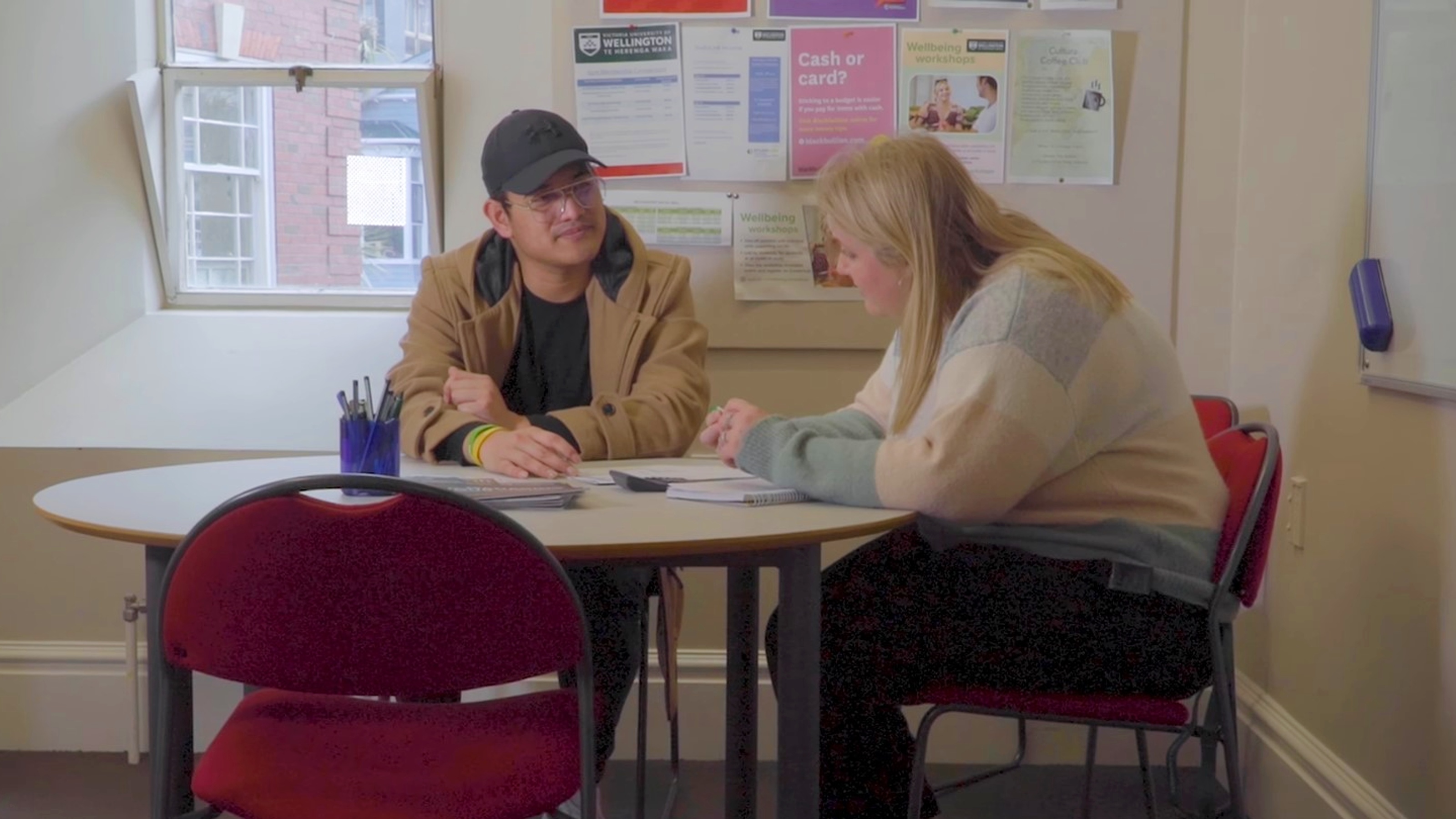
Get help to manage your finances
We can help you:
- budget your money
- manage your student loan or allowance
- work out your accommodation payment schedule.
If you’re facing financial difficulties, we can help you apply for the Hardship Fund.
You may be eligible for government or community support, too.
Apply for a New Zealand study visa
You’ll need to apply for a study visa if you plan to study with us as an international student.
You should apply for your visa after you’ve received your Offer of Place, and before you come to New Zealand.