

Fight a global problem
We already see the consequences of climate globally. The Master of Climate Change Science and Policy (MCCSP) is a cross-disciplinary programme that combines policy, economics, business, human behaviour, and physical science to address climate change.
International agreements aim to keep global warming below a two degree threshold to prevent more repercussions to people and the planet. We need to meet this goal, reduce emissions, and consider how we adapt to changes that have already happened. To do this, the world needs specialists who understand both physical sciences and human systems like policy, or social and economic structures.
Understand of climate change, and gain insight into how our society and systems are structured. Graduate ready to make change—informing effective climate strategies, or influencing government and policies.
Who can study for this qualification
To do an MSc you’ll need a Bachelor’s degree with an average grade of B+ or higher in your subject area.
You may also be able to qualify for entry if you have appropriate work or other experience.
Come from any study background
You don’t need to have a science degree to study for the Master of Climate Change Science and Policy.
You can come from any undergraduate degree—including arts, fine arts, law, engineering, business, or the social sciences.
Climate change affects everything and everyone, so any background is welcome.
What you’ll learn
During your MCCSP you’ll:
- develop your understanding of the physical nature of global climate change
- consider the ethical, scientific, and policy strengths and weaknesses of climate change strategies
- explore the political forces working for—and against—addressing climate change
- gain insight into the economics, politics, behavioural science, and public engagement critical to developing climate change strategies at a local, national, and global level.
How you’ll study
Part 1
Study compulsory courses and electives spread over Trimesters 1 and 2 to get a broad understanding of climate change issues.
Learn about the:
- physical aspects of climate change
- local, national, and global impacts
- history, present, and future of climate policy
- approaches to mitigating its effects.
Courses include disciplines across the Wellington Faculty of Science—from conservation ecology and meteorology to governance and psychology.
Choose from a range of elective courses to suit your interests or professional ambitions. Choose from the electives listed in Qualification requirements below, or ask the programme director about doing courses outside this list.
Part 2
The second part of the MCCSP takes place in Trimester 3. Choose between a research essay or a practicum placement and project.
Research essay
Investigate a climate-related topic of your choice in a major research project, coming together in an essay of up to 15,000 words.
Practicum placement and project
You’ll be placed with an employer in the field of climate change science, policy, or management, and complete a short research project.
Although we do our best to find a suitable employer for your topic, we cannot guarantee this as it depends on market conditions and opportunities. If we can't find the right employer, you can instead complete a research essay (CCSP510).
If you don’t complete the full Master’s
If you leave before completing the full programme, you may be able to graduate with a Postgraduate Certificate or Postgraduate Diploma in Science.
Entry requirements
Entry requirements for domestic students
- Requirements for students who completed university in:
If you live in New Zealand and are a citizen or permanent resident of New Zealand or Australia, you're considered a domestic student.
Some citizens of the Cook Islands, Niue, and Tokelau may automatically hold New Zealand citizenship.
Diplomatic residents living in New Zealand are also regarded as domestic students.
To be accepted into this qualification, you need:
1. (a) Before enrolment, a candidate for the MCCSP degree shall have:
(i) completed an undergraduate degree with a B grade average or better in a relevant subject; and
(ii) been accepted by the head of school as capable of proceeding with the proposed course of study.
(b) Requirement (a)(i) may be waived by the Associate Dean, Academic (Postgraduate) of the Faculty of Science for a candidate who has had extensive practical, professional, or scholarly experience that provides equivalent preparation.
Entry requirements
Your acceptance into this programme is based on your previous qualifications and experience.
Qualification requirements
Excerpt from the regulations for the MCCSP
2. The course of study for the MCCSP shall consist of courses worth 180 points, comprising:
Part 1: Physical Basis of Climate Change (CCSP 401), Climate Change Impacts and Adaptation (CCSP 402), International Climate Change Policy (CCSP 403), Climate Change Mitigation (CCSP 404)
Part 2: 60 points from Conservation Ecology (BIOL 420), Marine Biodiversity and Ecology (BIOL 423), CCSP 405, Special Topic: Emerging Topics in Climate Change in Aotearoa New Zealand and the Pacific (CCSP 408), CCSP 409, Environmental Management (ENVI 520), Environmental and Planning Law (ENVI 522), ENVI 524, Māori Environmental and Resource Management (ENVI 525), Political Ecology of Conservation (ENVI 526), Drivers of Human Behaviour (ENVI 530), Introduction to Geographic Information Science and its Applications (GEOG 415), GEOG 416, GEOS 401–479, Governance for Sustainability and Resilience (GOVT 542), Introduction to Dynamical Meteorology (GPHS 420), Cloud Physics and Boundary Layer Meteorology (GPHS 423), Numerical Weather Prediction (GPHS 425), Climatology and Remote Sensing (GPHS 426), PECO 517, PECO 520, Climate Dynamics (PHYG 413), PHYG 414, Natural Hazards and Risk: Processes and Impacts (PHYG 419), Hydrology and Water Resources (PHYG 420), Environmental Psychology (PSYC 405), Climate Change Communication (SCIS 417), or other courses approved by the head of school
Part 3: Research Essay (CCSP 510) or 511.
3. A full-time candidate whose course of study includes all parts shall be enrolled for at least three trimesters. The degree must be completed within three years. The associate dean may extend the maximum period in special cases.
4. Continuation to Part 3 requires a B+ (or better) average in Part 1, or permission of the head of school.
Postgraduate and industry connections
Postgraduate study will help you build valuable relationships and networks with peers, University staff, and future colleagues. Make the most of opportunities to attend events, seminars, workshops, and social functions.
You’ll also benefit from the expertise of working professionals through the Faculty’s connections with local industry and research institutions such as the New Zealand Climate Change Research Institute.
During your study, you’ll learn from guest lecturers from government agencies and the business sector. This is a great opportunity to hear from people practicing in this space already. Guest lecturers have included:
- the Minister of Climate Change
- senior analysts from Ministry for the Environment
- leaders in the insurance sector.
Future careers
The MCCSP gives you the skills and knowledge to make an impact in climate change roles like:
- policy development
- iwi development
- NGO advocacy.
You could also work in development studies areas like:
- climate change responses in the Pacific
- environmental law.
More career information
Find out more about career opportunities with the Master of Climate Change Science and Policy.
The government careers website, Tahatū, offers more information about jobs, salaries, and current opportunities.
Scholarships
You may be able to get a scholarship to help fund your studies.
We have postgraduate and doctoral scholarships available, as well as specialised scholarships for different groups and subject areas. If nothing fits right now, something may suit you later.
We encourage you to apply. It’s a straightforward process, and it could make a real difference.
Scholarships for the MCCSP
-
These scholarships are open to full-time or transferring students enrolling in a Master’s programme in Chemistry at the School of Chemical and Physical Sciences or in a Master’s programme at the New Zealand School of Music, Victoria University of Wellington.
-
Applicants must be of Pacific descent, be enrolled, or intending to enrol, in undergraduate or postgraduate studies, majoring in one or more of the following areas: Climate Change Science and Policy, Conservation Biology, Ecological Restoration, Ecology and Biodiversity, Environmental Science, Environmental Studies, Marine Biology, or Marine Conservation, and have a minimum GPA of GPA of 6.5. Applicants may be studying...
-
Applicants must be female, New Zealand or Canadian citizens studying full time at 300 level BSc (Hons) and Master's by Coursework in any area of Science, including Architecture and Design at Te Herenga Waka—Victoria University of Wellington.
Scholarships for international students
We are currently offering a NZ$10,000 VUW Postgraduate International Scholarship to all eligible international students enrolling in a Master’s degree or Postgraduate Diploma programme.
Your scholarship will be processed automatically when your programme application is accepted, and the amount will be deducted from your tuition fees.
Other scholarships
We also have postgraduate and doctoral scholarships available, as well as specialised scholarships for different groups and subject areas. If nothing fits right now, something may suit you later.
We encourage you to apply. It’s a straightforward process, and it could make a real difference.
Scholarships for the MCCSP
-
The purpose of this scholarship is to assist female students in the area of Mathematical Sciences or Geosciences to complete their M.Sc. or PhD thesis, by helping to extend enrolment in the final months of writing up their thesis.
-
The scholarship is open to students at the Masters by Thesis or PhD level at Te Herenga Waka—Victoria University of Wellington, with their research focusing on a long-term seismogenesis and long-range earthquake forecasting.
-
This scholarship is intended to assist with costs associated with pursuing a Master’s research degree in any research topic related to New Zealand/Aotearoa.
Join our postgraduate community
The Postgraduate Students’ Association provides a voice for you on campus and information on studying at Te Herenga Waka—Victoria University of Wellington.
Postgraduate Students’ Association
MAI ki Pōneke
MAI ki Pōneke are part of an international network of Māori and Indigenous postgraduate students. They provide advice, support, and information to Indigenous postgraduate students of all levels, as well as those thinking about enrolling.
Degree support and advice
We can help you match your interests and career goals with the right course of study.
If you’re a new student, talk to a Future Student Adviser.
If you’re already studying with us, talk to Tītoko—Student Success.

Research an area that interests you
Te Herenga Waka—Victoria University of Wellington is New Zealand’s top-ranked university for intensity of high-quality research.
Faculty of Science research rankings
As part of your Master’s study, you may conduct research in an area of your choice. The research essay in Trimester 3 is like a mini-thesis. It cover anything related to climate change— from changes in regional climate, to misinformation, to how international negotiations do or do not work.
You’ll learn from and research under the supervision of highly qualified academic staff and professional researchers who do internationally recognised work.
School of Geography, Environment and Earth Sciences research
Research institutes
You’ll also have access to knowledge from academics from across the Faculty of Science, including specialists from:
Academic staff research areas
Kyle Clem
Senior Lecturer in Climate Science
Cathrine Dyer

Lecturer
Gerhard Reese

Associate Professor
James Renwick
Presenter

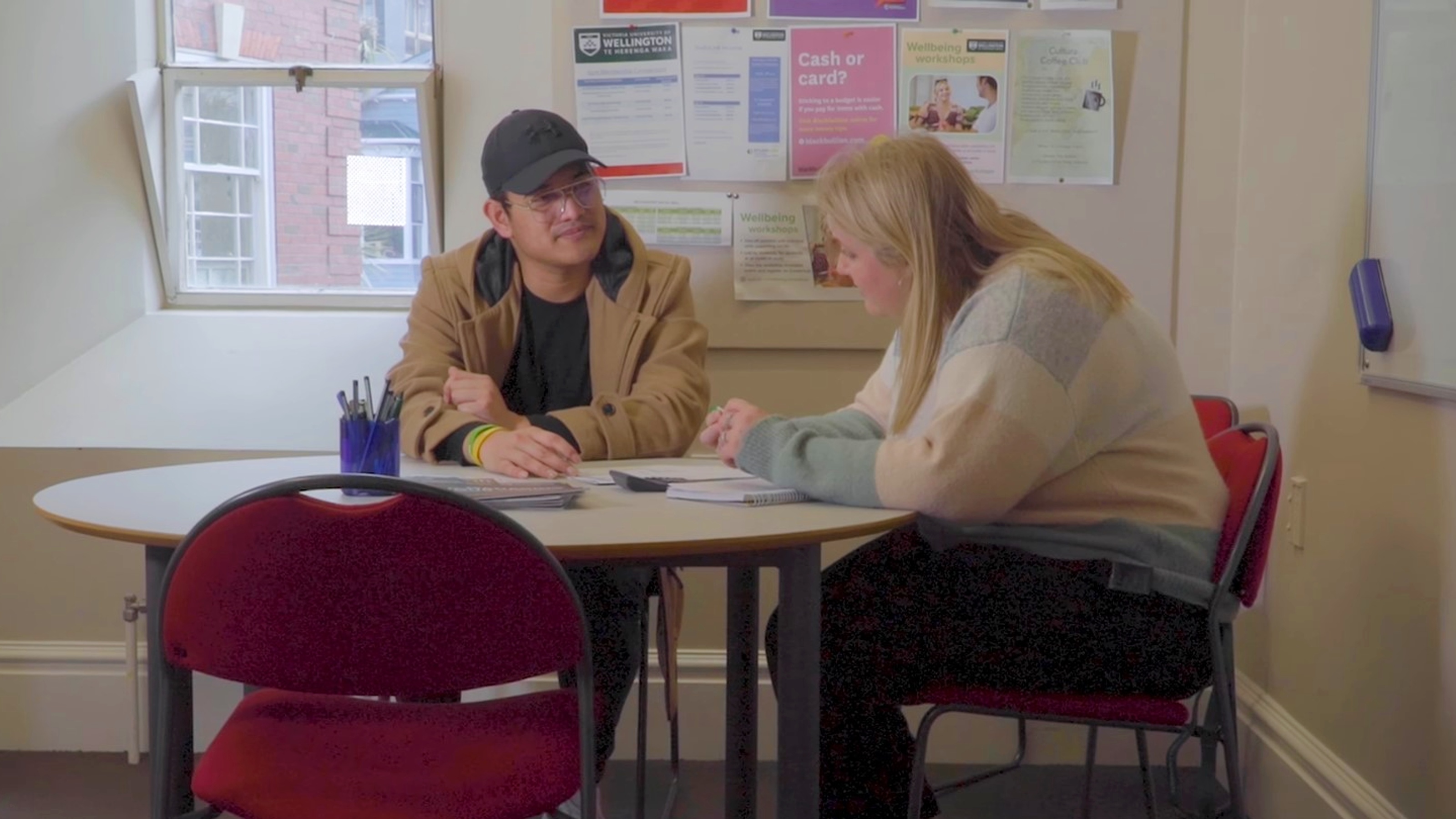
Get help to manage your finances
We can help you:
- budget your money
- manage your student loan or allowance
- work out your accommodation payment schedule.
If you’re facing financial difficulties, we can help you apply for the Hardship Fund.
You may be eligible for government or community support, too.
Apply for a New Zealand study visa
You’ll need to apply for a study visa if you plan to study with us as an international student.
You should apply for your visa after you’ve received your Offer of Place, and before you come to New Zealand.