

Master advanced clinical and research techniques
Combine biological sciences with chemistry to develop the skills to target, design, synthesise, create, and assess new drugs. Learn how to identify drug targets and develop them into new therapeutics.
You can study courses to develop skills to protect intellectual property, assess the financial viability of drugs, and negotiate the path through pre-clinical and clinical trials.
Who can study for the qualification
To get into this programme, you’ll need a Bachelor’s degree—preferably in chemistry or a relevant science subject such as biochemistry, biomedical science, pharmacy, or pharmacology.
What you’ll learn
In the MDDD, you’ll learn about the development of approved drugs and the modern techniques used to optimise them.
You’ll learn aspects of drug development such as:
- handling chemicals on a large scale in a way that is safe, reliable, and robust
- the analytical methods used to characterise the drug process.
You’ll also learn about real-world issues facing pharmaceutical development.
Specialisations
Within the MDDD, you can choose a specialisation in an area of interest—Chemical Biology, Drug Development, or Drug Discovery.
To qualify for a specialisation, you need to include at least 45 points in approved courses at 400- or 500-level. Details about which courses are required for each specialisation are in the University Calendar.
How you’ll study
Study for the MDDD in two parts over three trimesters.
- Part 1—focus on coursework and prepare for the practical research component.
- Part 2—complete an individual research project.
Your research project will involve conducting experiments and writing up a final report.
The projects cover a wide range of disciplines, including:
- new natural product discovery and characterisation
- organic synthesis
- drug molecular modelling.
Learn from leaders in the field
Academic and industry specialists teach your courses, giving you access to a wide range of real-world research and development expertise.
Learn from academics and professionals who have experience in successfully taking drugs to market and in the local and international biotech industry.
Ferrier Research Institute teaches the programme in partnership with:
Master of Drug Discovery and Development
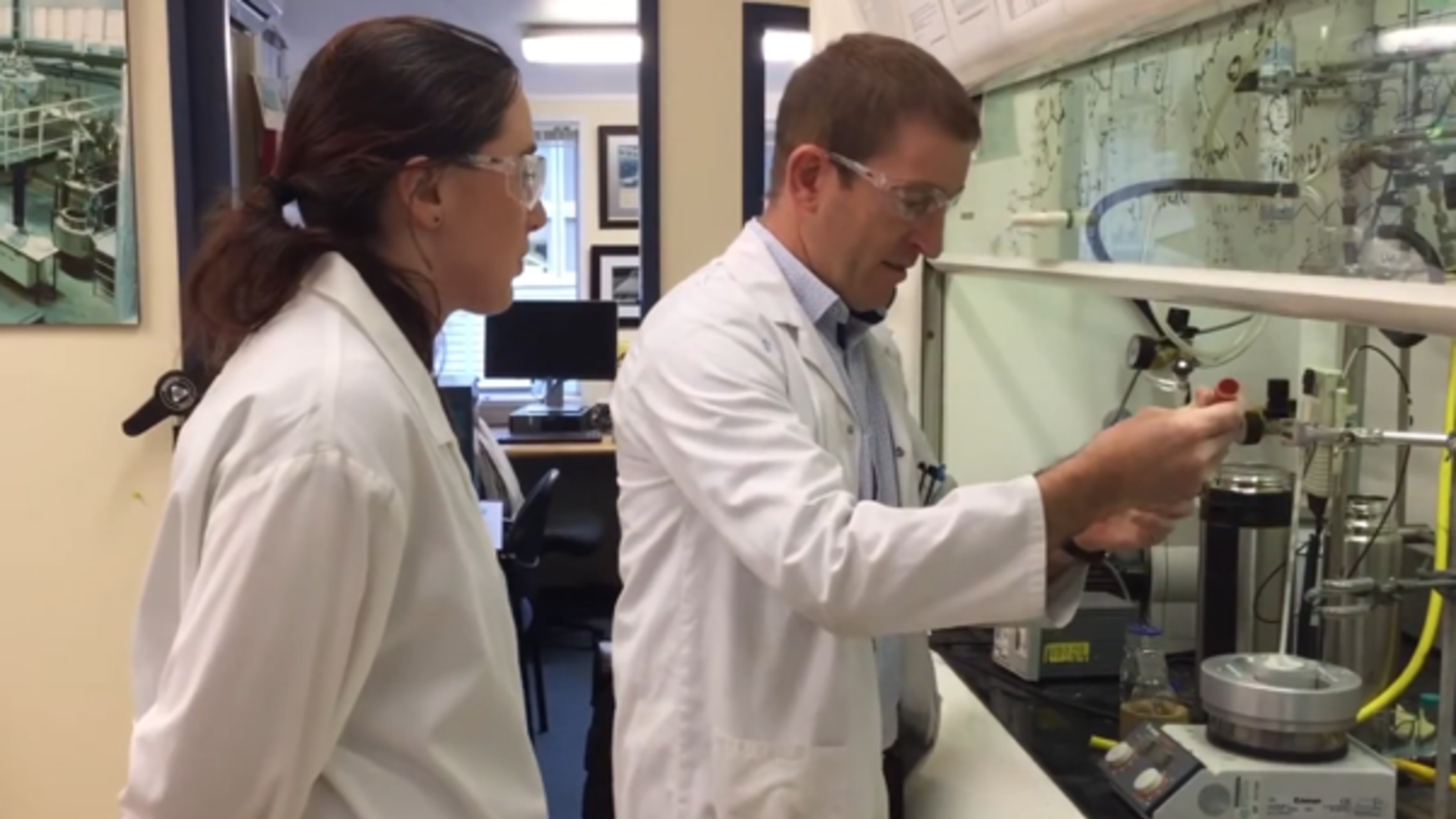
Dr. Simon Hinkley from the Ferrier Research Institute and two students discuss the Master of Drug Discovery and Development and the study experience.
Flexible study options
The MDDD is part of a tiered family of qualifications:
- Master of Drug Discovery and Development (180 points)
- Postgraduate Diploma in Drug Discovery and Development (120 points)
- Postgraduate Certificate in Drug Discovery and Development (60 points).
These qualifications are ‘staircased’. If you start with the Diploma or Certificate and want to continue studying after you finish, your completed courses can count towards the Master’s.
Or, if you enrol in the Master’s but choose not to finish it, you may have completed enough courses to be awarded a Diploma or Certificate.
Choose the qualification that suits your career goals, time constraints, and financial situation.
Qualification support and advice
We can help you match your interests and career goals with the right course of study.
If you’re a new student, talk to a Future Student Adviser through our enquiry form.
If you’re already studying with us, talk to Tītoko—Student Success.
For the research portion of your study, you’ll need a supervisor to help guide your research. Your programme coordinator will work with you to find the right person.

Entry requirements
Entry requirements for domestic students
- Requirements for students who completed university in:
If you live in New Zealand and are a citizen or permanent resident of New Zealand or Australia, you're considered a domestic student.
Some citizens of the Cook Islands, Niue, and Tokelau may automatically hold New Zealand citizenship.
Diplomatic residents living in New Zealand are also regarded as domestic students.
To be accepted into this qualification, you need:
1. (a) Before enrolment, a candidate for the MDDD degree shall have:
(i) completed a degree of a tertiary education institution in New Zealand or equivalent in Chemistry or a relevant life-science subject, such as Biochemistry, Biomedical Science, Pharmacy, Pharmacology, normally with a B+ average grade or better in relevant courses; and
(ii) been accepted by the relevant head of school as capable of proceeding with the proposed course of study.
(b) Requirement (a)(i) may be waived by the Associate Dean, Academic (Postgraduate) for a candidate who has had extensive practical, professional, or scholarly experience of an appropriate kind.
Qualification requirements
Excerpt from the regulations for the MDDD
2. The course of study for the MDDD shall consist of:
Part 1: (i) Chemical Biology and Drug Discovery (DRGD 401); one of Drug Design (DRGD 402), Organic and Bio-organic Chemistry (CHEM 421)
(ii) A further 60 points from BIOL 430–440, BMSC 400–441, BTEC 435–441, CHEM 400–441, CLNR 401–405, DRGD 402–403, MBIO 434–440
(iii) Research Preparation (DRGD 580)
Part 2: Applied Research Project (DRGD 561) or 590.
3. With the programme director’s permission, a candidate may replace Part 1(iii) and Part 2 of the MDDD with Research Thesis (DRGD 595).
4. A candidate for the MDDD degree shall normally be enrolled for at least three trimesters and shall complete the degree within two years of first enrolling. The associate dean may extend the maximum period in special cases.
5. A candidate who has completed the PGDipDDD or PGCertDDD and is accepted into the MDDD may transfer the courses passed to the MDDD, but must abandon the earlier qualification upon being awarded the degree.
6. A candidate may, with the permission of the programme director, replace optional courses with substitute courses chosen from those offered for postgraduate Honours or Master’s degrees. (See section 5.5 of the General Programmes of Study Regulations for the general provisions concerning the substitution of courses.)
Research an area that interests you
Be part of a dynamic and collaborative scientific research community. Past students’ research areas in drug discovery and development include:
- development of a new scaled-up catalytic process for a high-value fine chemical
- isolation and characterisation of a novel bioactive from a New Zealand marine organism
- formulation of a novel therapeutic for cancer immunotherapy.
Find out about research areas at the Ferrier Institute.
Get hands-on research experience
The MDDD gives you first-hand experience with the Ferrier Research Institute’s drug design and development research activities. You’ll work alongside the largest carbohydrate research team in the world, with more than 50 scientists.
The Institute also has its own manufacturing facility, where you can observe the drug development process from initial discovery to final product.
The MDDD programme has links with the Centre for Biodiscovery. Through the Centre, you’ll interact with the wider University research community as they actively discover, design, and assess novel bioactive compounds.
Future careers
Develop the broad skills you need to work in drug discovery in:
- companies
- universities
- research institutes
- drug regulatory authorities.
More career information
Find out more about careers in biomedical science.
The government careers website, Tahatū, offers more information about jobs, salaries, and current opportunities.
Scholarships
You may be able to get a scholarship to help fund your studies.
We have postgraduate and doctoral scholarships available, as well as specialised scholarships for different groups and subject areas. If nothing fits right now, something may suit you later.
We encourage you to apply. It’s a straightforward process, and it could make a real difference.
Scholarships for Biomedical Science
There could be a scholarship for your qualification, subject area, background, or situation.
Scholarships for international students
We are currently offering a NZ$10,000 VUW Postgraduate International Scholarship to all eligible international students enrolling in a Master’s degree or Postgraduate Diploma programme.
Your scholarship will be processed automatically when your programme application is accepted, and the amount will be deducted from your tuition fees.
Other scholarships
We also have postgraduate and doctoral scholarships available, as well as specialised scholarships for different groups and subject areas. If nothing fits right now, something may suit you later.
We encourage you to apply. It’s a straightforward process, and it could make a real difference.
Scholarships for Biomedical Science
There could be a scholarship for your qualification, subject area, background, or situation.
Join our postgraduate community
The Postgraduate Students’ Association provides a voice for you on campus and information on studying at Te Herenga Waka—Victoria University of Wellington.
Postgraduate Students’ Association
MAI ki Pōneke
MAI ki Pōneke are part of an international network of Māori and Indigenous postgraduate students. They provide advice, support, and information to Indigenous postgraduate students of all levels, as well as those thinking about enrolling.
Study for a PhD
Once you’ve completed your MDDD, if you want to pursue an academic or research career, you’ll be eligible to apply for PhD programmes, carrying out original and sustained research under supervision from world-class academics in the Wellington Faculty of Science.
The lecturers in this programme have published over 100 papers on drug development and are inventors on more than 20 US patents. Several of their inventions, drugs, and drug technologies are currently in human clinical trials for the treatment of diseases as diverse as cancer and gout.
Academic staff research interests
Richard Furneaux
Distinguished Scientist
Lawrence Harris
Science Team Leader
Simon Hinkley

Science Team Leader
Rob Keyzers
Head of School
Farah Lamiable-Oulaidi
Senior Scientist
Gavin Painter
Science Team Leader
Mattie Timmer
Associate Professor
Helen Woolner
Senior Lecturer
Get help to manage your finances
We can help you:
- budget your money
- manage your student loan or allowance
- work out your accommodation payment schedule.
If you’re facing financial difficulties, we can help you apply for the Hardship Fund.
You may be eligible for government or community support, too.

Apply for a New Zealand study visa
You’ll need to apply for a study visa if you plan to study with us as an international student.
You should apply for your visa after you’ve received your Offer of Place, and before you come to New Zealand.