

Understand global strategy, power, and security
Study for this globally recognised Master’s degree at the Centre for Strategic Studies in Wellington.
This Master’s degree develops your practical understanding of political and economic strategy around the world. You’ll study the history of strategic thinking since the 19th century, and explore how security is managed around the world. Examine Aotearoa New Zealand's role in world politics and how strategic thinking applies to the geopolitical issues shaping world events.
The degree builds the practical policy, analytical, and research skills you need for senior public sector careers in New Zealand and abroad. You’ll also be able to contribute original research to the analysis of global security and strategy issues.
Who can study for this qualification
The MSS helps you understand strategic responses to our changing global political environment.
It suits you if you are:
- a recent graduate and want to build a career in the strategy and security field
- already working—perhaps as a defence or government policy professional—and need to advance your knowledge of strategic and security issues for senior roles
- looking for a Master's degree that combines coursework with independent research.
You can enrol in the MSS if you have a Bachelor’s degree with at least a B average in 60 points of 300-level courses in your majoring subject or in a relevant study area.
Our Postgraduate Strategic Studies qualifications
We offer two Postgraduate Strategic Studies qualifications. These are staircased so that courses completed for one can count towards the next step.
The 180-point Master of Strategic Studies provides the most comprehensive study as it combines coursework with a research course.
The 120-point Postgraduate Diploma in Strategic Studies has in-depth study and includes the same courses as the Master's, but not the research course.
What you’ll learn
The MSS combines coursework with research.
Coursework
Your core coursework covers the foundations of Strategic Studies and places them within the context of New Zealand’s approach to its security. You’ll examine:
- the history of strategic thinking from Clausewitz to the 21st century, including how strategy has limited international competition and has tried to restrain the use of force
- New Zealand Foreign and Security Policy—including New Zealand’s approach to regional issues in the Asia-Pacific region, our trade, security and defence policy, and our bilateral and multilateral relationships.
Choose from a wide range of Strategic Studies, International Politics, and Political Science courses.
You could study:
- International Political Economy—the interactions between today’s economies and political institutions at national and international levels, and in relation to specific issue areas like international trade, finance, international institutions, and globalisation
- international cooperation—when and why states cooperate, how they structure their cooperation, and what roles other domestic and international organisations play in the process
- Asian security—theories of conflict and regional order as they apply to the Asia–Pacific region
- contemporary democratic theory—what justifies democracy, and how it can work in modern societies
- media and election campaigns—how media, communication, and politics interact, especially within political campaigns and elections
- war gaming and analytic tradecraft—how to design strategies that shape national security decisions.
Research essay or dissertation
Deepen your research skills and experience, and develop specific expertise in a Strategic Studies area of your choice. You’ll carry out a detailed examination of a strategic studies research topic supervised by an expert from the school.
How you'll learn
The 180-point MSS is in two parts—taught courses and a research component. Studying full time, you'll complete the degree in one year.
Part 1: Taught courses
You’ll complete four courses:
- two compulsory courses
- two electives from the range of topics set out in the previous section.
Your courses will be a series of lectures that you attend in person or online. Many courses are available in the late afternoon or early evening. You should attend in person if you can—most courses involve class discussions, debates, and group work.
Part 2: Research
Choose between:
- a 60-point dissertation
- a 30-point research essay or project and approved taught courses.
You could also get permission from the head of school to do a 90-point thesis in place of the Part 2 research component and some Part 1 courses.
Students work with a supervisor to present their original research as a thesis. Your research is usually in the same discipline that you studied at undergraduate level, and it can lead to PhD study.
Part-time study options
Studying part time, you'll complete the MSS over a maximum of two years.
Qualification support and advice
We can help you match your interests and career goals with the right course of study.
If you’re a new student, talk to a Future Student Adviser through our enquiry form.
If you’re already studying with us, talk to Tītoko—Student Success.
For the research portion of your study, you’ll need a supervisor to help guide your research. Your programme coordinator will work with you to find the right person.

Entry requirements
Entry requirements for domestic students
- Requirements for students who completed university in:
If you live in New Zealand and are a citizen or permanent resident of New Zealand or Australia, you're considered a domestic student.
Some citizens of the Cook Islands, Niue, and Tokelau may automatically hold New Zealand citizenship.
Diplomatic residents living in New Zealand are also regarded as domestic students.
To be accepted into this qualification, you need:
1. (a) Before enrolment, a candidate for the MSS degree shall have:
(i) completed a Bachelor’s degree in a relevant area with at least a B grade average in 60 points of 300-level courses in the majoring subject or relevant area of study; and
(ii) been accepted by the head of school as capable of proceeding with the proposed course of study.
(b) Requirement (a)(i) may be waived by the Associate Dean (Students) of the Faculty of Humanities and Social Sciences for a candidate who has had extensive practical, professional, or scholarly experience that provides an equivalent level of preparation.
Qualification requirements
2. The course of study for the MSS shall consist of:
Part 1: (a) Strategic Studies (STRA 531);
(b) 60 points from New Zealand Foreign and Security Policy (STRA 515), STRA 530–588; and
(c) 30 further points from New Zealand Foreign and Security Policy (STRA 515), STRA 530–588 or INTP 400–488, POLS 400–488.
Part 2: (a) Dissertation (STRA 526); or
(b) Research Essay (STRA 519) or 527; and 30 further points from INTP 400–488, POLS 400–488 or New Zealand Foreign and Security Policy (STRA 515), STRA 530–588.
3. A full-time candidate shall normally complete the requirements of the degree by 28 February in the year after first enrolling for it, and each part-time candidate shall normally complete the requirements for the degree by 28 February in the second year after first enrolling. The associate dean may extend those periods in special cases.
Globally ranked
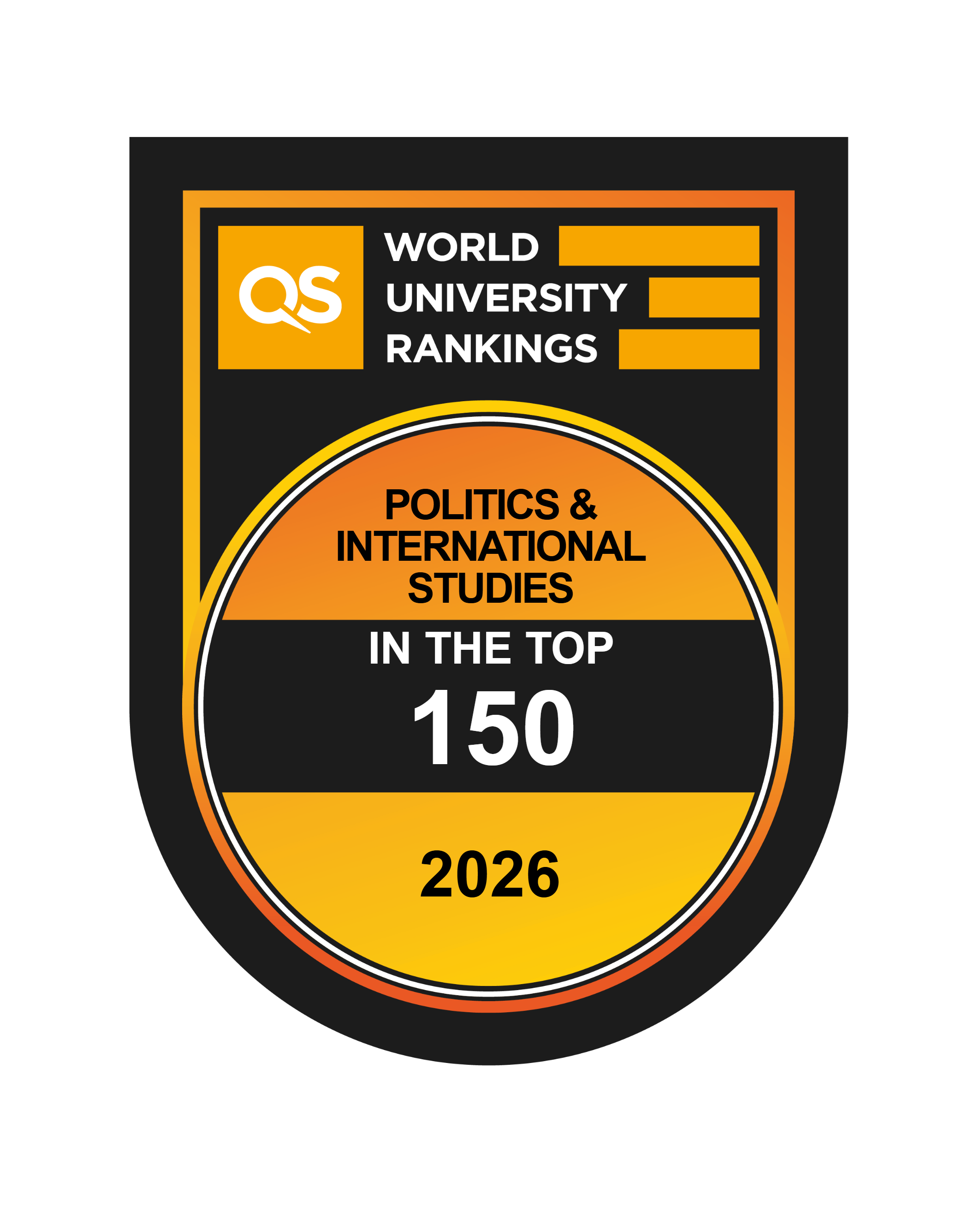
Our Political Science and International Relations subjects are ranked in the top 150 worldwide in the QS World University Rankings 2026.
The QS World University Rankings is an annual global publication that gives overall rankings and subject rankings for more than 1,500 universities worldwide.
Future careers
Graduates in fields related to Political Science work across the private and public sectors. They may work in political environments as well as in non-profits, NGOs, and government departments.
The MSS gives you the specific expertise for work in the wider security community, such as with:
- government
- research organisations and think tanks
- civil society
- the private sector.
You might work in policy, research, assessment, or analysis jobs in organisations with a foreign affairs, defence, or intelligence role.
Strategic Studies students have a good chance of getting an internship in New Zealand or overseas—a good way to set up your career here or further afield.
More career information
Find out more about careers.
The government careers website, Tahatū, offers more information about jobs, salaries, and current opportunities.
Scholarships
You may be able to get a scholarship to help fund your studies.
We have postgraduate and doctoral scholarships available, as well as specialised scholarships for different groups and subject areas. If nothing fits right now, something may suit you later.
We encourage you to apply. It's a straightforward process, and it could make a real difference.
Scholarships for Humanities and Social Sciences
-
The Erasmus Scholarship is open to second year students at Te Herenga Waka—Victoria University of Wellington who want to major in Greek or Latin.
-
This scholarship is offered to women graduates intending to study at Victoria University of Wellington in a course leading to a higher degree, which includes research in some field related to the general purpose of teaching or promoting the knowledge of home or domestic science among the women of New Zealand (e.g. Sociology, Psychology, Education or Science).
-
This scholarship has been established in honour of Sir Lloyd Geering to support students undertaking postgraduate study in Religious Studies. Sir Lloyd was the founding Professor of Religious Studies at Victoria University of Wellington in 1971. He contributed greatly to the study of religion in New Zealand and to thinking about transformations of religion in modernity. The horizons of his...
Scholarships for international students
We're currently offering a NZ$10,000 VUW Postgraduate International Scholarship to all eligible international students enrolling in a Master’s degree or Postgraduate Diploma programme.
Your scholarship will be processed automatically when your programme application is accepted, and the amount will be deducted from your tuition fees.
Other scholarships
We also have postgraduate and doctoral scholarships available, as well as specialised scholarships for different groups and subject areas. If nothing fits right now, something may suit you later.
We encourage you to apply. It's a straightforward process, and it could make a real difference.
Scholarships for Humanities and Social Sciences
-
The Erasmus Scholarship is open to second year students at Te Herenga Waka—Victoria University of Wellington who want to major in Greek or Latin.
-
This scholarship is offered to women graduates intending to study at Victoria University of Wellington in a course leading to a higher degree, which includes research in some field related to the general purpose of teaching or promoting the knowledge of home or domestic science among the women of New Zealand (e.g. Sociology, Psychology, Education or Science).
-
This scholarship has been established in honour of Sir Lloyd Geering to support students undertaking postgraduate study in Religious Studies. Sir Lloyd was the founding Professor of Religious Studies at Victoria University of Wellington in 1971. He contributed greatly to the study of religion in New Zealand and to thinking about transformations of religion in modernity. The horizons of his...
Join our postgraduate community
The Postgraduate Students’ Association provides a voice for you on campus and information on studying at Te Herenga Waka—Victoria University of Wellington.
Postgraduate Students’ Association
MAI ki Pōneke
MAI ki Pōneke are part of an international network of Māori and Indigenous postgraduate students. They provide advice, support, and information to Indigenous postgraduate students of all levels, as well as those thinking about enrolling.
Why Wellington
By studying at the School of History, Philosophy, Political Science and International Relations, you’ll be part of our integrated Political Science and International Relations programme. You’ll have access to experts with academic—and practical—expertise in a range of related areas like International Relations, Political Science, and Comparative Politics.
You’ll also study alongside the Centre for Strategic Studies, our globally ranked think-tank at Victoria University of Wellington. You’ll be able to attend seminars and workshops organised by the Centre that feature leading scholars and practitioners from across the region and the world.
Study for a PhD
If you do well in your Master’s degree and show an aptitude for advanced research, you could apply to do a PhD—the highest-level qualification we offer.
You’ll carry out original and sustained research, supervised by our world-class academics.
As a PhD candidate, you’ll also be supported by the Faculty of Graduate Research.
Academic staff research areas
Ayca Arkilic

Senior Lecturer
David Capie

China Capable Masterclass Presenter
Matthew Castle

Senior Lecturer in International Relations
Jon Fraenkel

Professor of Comparative Politics
Xiaoming Huang

Professor of International Relations
Iati Iati

Senior Lecturer
Van Jackson

Associate Professor
Manjeet Pardesi

Associate Professor
Kate Schick

Associate Professor
Jason Young

Director, NZ Contemporary China Research Centre
Get help to manage your finances
We can help you:
- budget your money
- manage your student loan or allowance
- work out your accommodation payment schedule.
If you’re facing financial difficulties, we can help you apply for the Hardship Fund.
You may be eligible for government or community support, too.

Apply for a New Zealand study visa
You’ll need to apply for a study visa if you plan to study with us as an international student.
You should apply for your visa after you’ve received your Offer of Place, and before you come to New Zealand.