

Help people make positive change
The PGDipClinPsyc will give you the practical skills and knowledge you need to register and practise as a clinical psychologist. Learn to understand, assess, and treat a range of psychological, emotional, and behavioural difficulties, and prepare for a career helping to improve mental health.
Gain expertise in the scientific methods of clinical practice and learn to combine compassion and respect for others with excellence in practice.
This full-time, three-year professional course of study is a clinical training programme that is completed alongside a Master’s or PhD research thesis. You’ll graduate with a PGDipClinPsyc and a Master’s or PhD degree.
Who can study for a PGDipClinPsyc
Entry into the qualification is limited to around 18 students each year. To apply, you’ll need:
- a first-class Honours degree in Psychology (or be close to completing one), or
- an A- average in Part 1 of a specialist MSc degree in Psychology.
You’ll also need to have passed the following undergraduate courses:
- PSYC232 (Survey and Naturalistic Research Methods)
- PSYC233 (Brain and Behaviour)
- PSYC242 (Experimental Research Methods)
- PSYC321 (Clinical Applications of Psychology)
- PSYC327 (Cognitive and Behavioural Neuroscience)
- PSYC332 (Behaviour Analysis)
In your Honours year or in Part 1 of your Master’s, you can focus on subjects that interest you.
Read the application form carefully and make sure you are familiar with the key selection criteria. You’ll need to demonstrate your commitment to biculturalism. For example, you could complete a basic Te Reo Māori language and culture course, or attend a Treaty of Waitangi workshop.
For extracurricular activities, such as work or volunteering, choose experience in the area of support work that interests you. It will give you a real sense of what the job involves.
Final acceptance is conditional on a police check.
What and how you’ll study
The Clinical Psychology training programme takes a minimum of three years to complete. The PGDipClinPsyc can only be completed full-time and on campus.
Year 1
In your first year, you’ll complete compulsory clinical courses that cover topics in adult, child, and adolescent clinical psychology. You can begin your Master of Science (MSc) or PhD thesis at the same time.
Year 2
Your second year includes a 60-point practicum. You’ll attend taught workshops and work with clients in our clinic.
At the same time, you’ll complete your Master’s thesis or work on your PhD.
If you choose to do a PhD, you’ll take leave from the programme to complete your thesis and then rejoin it to complete Years 2 and 3.
If you are completing an MSc, you can choose a focus on general Psychology, Forensic Psychology, or Cognitive and Behavioural Neuroscience. Discuss these options with the programme directors before you enrol.
Year 3
In the final year of the PGDipClinPsyc, you’ll complete an advanced practicum (internship), and one core course. You’ll spend 1,500 hours—or four days a week—in a supervised clinical placement for your internship, and attend classes one day a week in the first trimester. Your course will cover advanced psychological interventions for adults, children, and family systems.
You will sit a final exam at the end of Year 3.
Application process
Applications will be shortlisted. If you are shortlisted, you'll be invited to an interview panel at the School of Psychological Sciences. If you are successful, you will be granted provisional entry to the first year of the programme.
Because places are so limited in the PGDipClinPsyc, you should consider enrolling in other study options alongside your PGDipClinPsyc application, so that you meet enrolment deadlines for alternative programmes.
If you’re accepted into the clinical programme after you’ve already enrolled in another programme, your enrolment will be moved to the clinical programme.
Entry requirements
Entry requirements for domestic students
- Requirements for students who completed university in:
If you live in New Zealand and are a citizen or permanent resident of New Zealand or Australia, you're considered a domestic student.
Some citizens of the Cook Islands, Niue, and Tokelau may automatically hold New Zealand citizenship.
Diplomatic residents living in New Zealand are also regarded as domestic students.
To be accepted into this qualification, you need:
1. (a) Before enrolment, a candidate for the PGDipClinPsyc shall have:
(i) completed a BSc(Hons) or BA(Hons) in Psychology, or completed the coursework for Part 1 of the MSc in Psychology, or passed 120 400-level Psychology points (or their equivalent) and passed both PSYC 451 and 452 with at least an A– grade in each;
(ii) enrolled for or completed an MA or PhD or Part 2 of the MSc degree by thesis; and
(iii) been accepted by the head of school as capable of proceeding with the proposed course of study.
Note: A candidate who has completed a Bachelor’s degree in Psychology and signalled their intention to enrol in the PGDipClinPsyc may be granted, during their Honours year, provisional admission to the PGDipClinPsyc by the head of school, on the recommendation of the programme director. For details about provisional admission refer to the School of Psychology website at www.wgtn.ac.nz/psyc
(b) Requirements (a)(i), (ii) and (iii) may be waived by the Associate Dean, Academic (Postgraduate), on the recommendation of the programme director, for a candidate who is otherwise suitably qualified.
The PSYC451 and PSYC452 are completed in the pre PGDipClinPsyc year.
Qualification requirements
Excerpt from the regulations for the PGDipClinPsyc
2. The course of study for the diploma shall consist of courses worth 210 points, including:
Part 1: Practicum (PSYC 561); and
Part 2: Advanced Practicum (PSYC 562), Adult and Child Clinical Psychology: Advanced Intervention Skills (PSYC 574).
3. Entry to Part 2 requires the candidate to have submitted for examination the thesis for the degree referred to in 1(a)(iii), and normally completed Part 1.
4. A candidate shall normally be enrolled for at least four trimesters and shall complete the diploma within three years of first enrolling in it. The associate dean may extend the maximum period in exceptional circumstances.
5. The associate dean may, on the recommendation of the programme director, cancel the enrolment of a candidate whose progress is unsatisfactory.
6. Courses from the PGDipClinPsyc regulations are excepted from the Aegrotat Pass provisions in the Assessment Handbook. In the event that a candidate is prevented from completing such a course by one of the circumstances specified in the relevant section of the Assessment Handbook, the programme director may grant the candidate an extension to complete the placement.
Degree support and advice
We can help you match your interests and career goals with the right course of study.
If you’re a new student, talk to a Future Student Adviser.
If you’re already studying with us, talk to Tītoko—Student Success.

Join the Victoria Students’ Psychology Society
Come along to the annual quiz night, talks by guest speakers, movie nights, and other social events aimed at bringing students and staff together.
Future careers
With a Postgraduate Diploma in Clinical Psychology, you are able to register and work as a clinical psychologist. You could work within health, corrections, or a range of community settings.
If you have combined your clinical training with a PhD, you could go on to a career in academia.
More career information
Find out more about careers in clinical psychology.
The government careers website, Tahatū, offers more information about jobs, salaries, and current opportunities.
Scholarships
You may be able to get a scholarship to help fund your studies.
We have postgraduate and doctoral scholarships available, as well as specialised scholarships for different groups and subject areas. If nothing fits right now, something may suit you later.
We encourage you to apply. It's a straightforward process, and it could make a real difference.
Scholarships for Clinical Psychology
-
Applicants must be full-time post graduate student studying at Victoria University of Wellington. This scholarship is open to students from any course of study which focuses on social justice but students studying Criminology, Psychology, Sociology, Law and Restorative Justice are encouraged to apply. Students holding a full three-year PhD scholarship are not eligible to apply.
-
The VSPS constitution states "The Psychology Society offers a range of events that enrich the study of psychology, bring together students at all levels of study, and foster a relationship between students and academic staff outside the classrooms".
Scholarships for international students
We're currently offering a NZ$10,000 VUW Postgraduate International Scholarship to all eligible international students enrolling in a Master’s degree or Postgraduate Diploma programme.
Your scholarship will be processed automatically when your programme application is accepted, and the amount will be deducted from your tuition fees.
Other scholarships
We also have postgraduate and doctoral scholarships available, as well as specialised scholarships for different groups and subject areas. If nothing fits right now, something may suit you later.
We encourage you to apply. It's a straightforward process, and it could make a real difference.
Scholarships for Clinical Psychology
-
The VSPS constitution states "The Psychology Society offers a range of events that enrich the study of psychology, bring together students at all levels of study, and foster a relationship between students and academic staff outside the classrooms".
Join our postgraduate community
The Postgraduate Students’ Association provides a voice for you on campus and information on studying at Te Herenga Waka—Victoria University of Wellington.
Postgraduate Students’ Association
MAI ki Pōneke
MAI ki Pōneke are part of an international network of Māori and Indigenous postgraduate students. They provide advice, support, and information to Indigenous postgraduate students of all levels, as well as those thinking about enrolling.
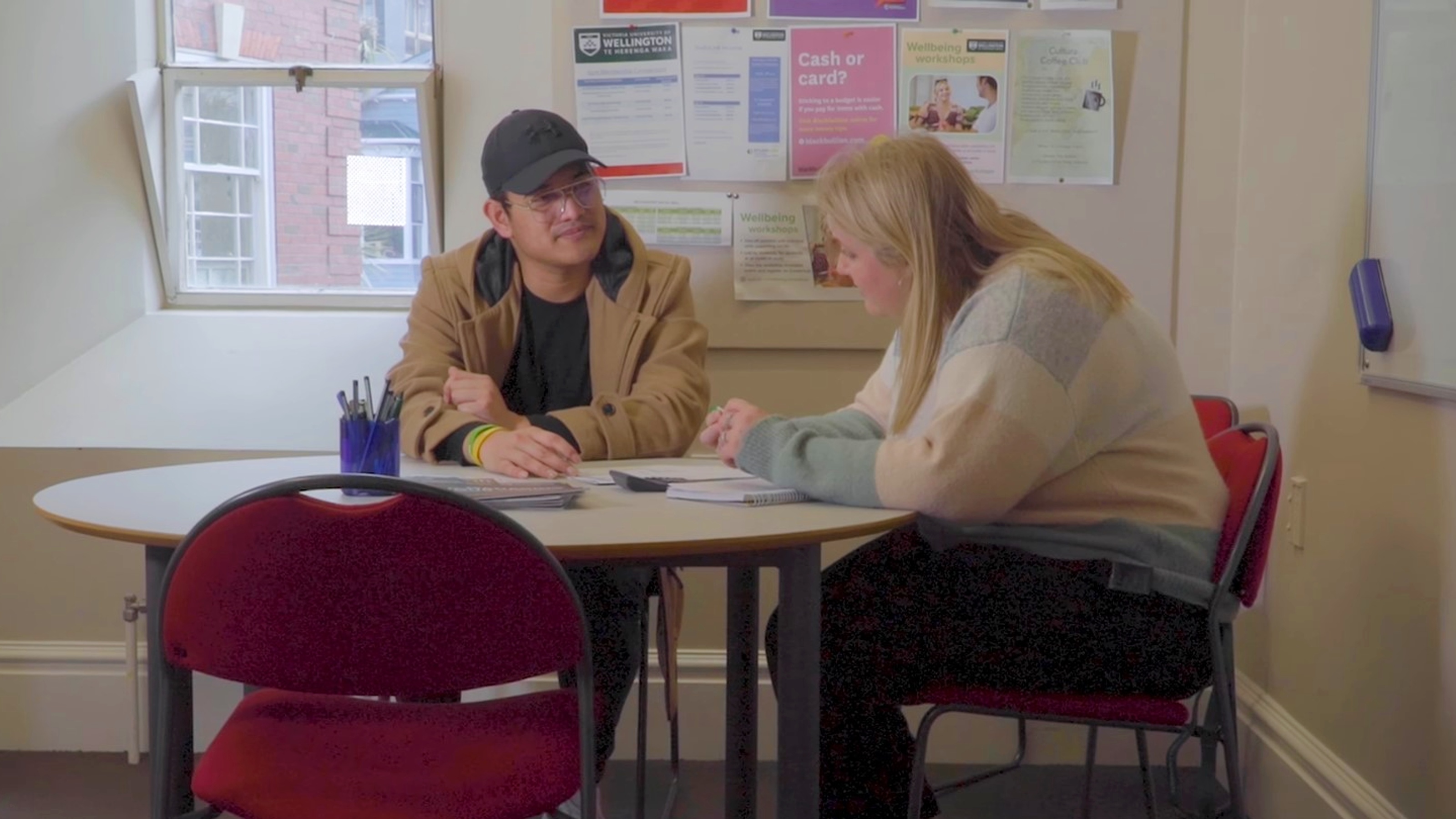
Get help to manage your finances
We can help you:
- budget your money
- manage your student loan or allowance
- work out your accommodation payment schedule.
If you’re facing financial difficulties, we can help you apply for the Hardship Fund.
You may be eligible for government or community support, too.
Apply for a New Zealand study visa
You’ll need to apply for a study visa if you plan to study with us as an international student.
You should apply for your visa after you’ve received your Offer of Place, and before you come to New Zealand.