
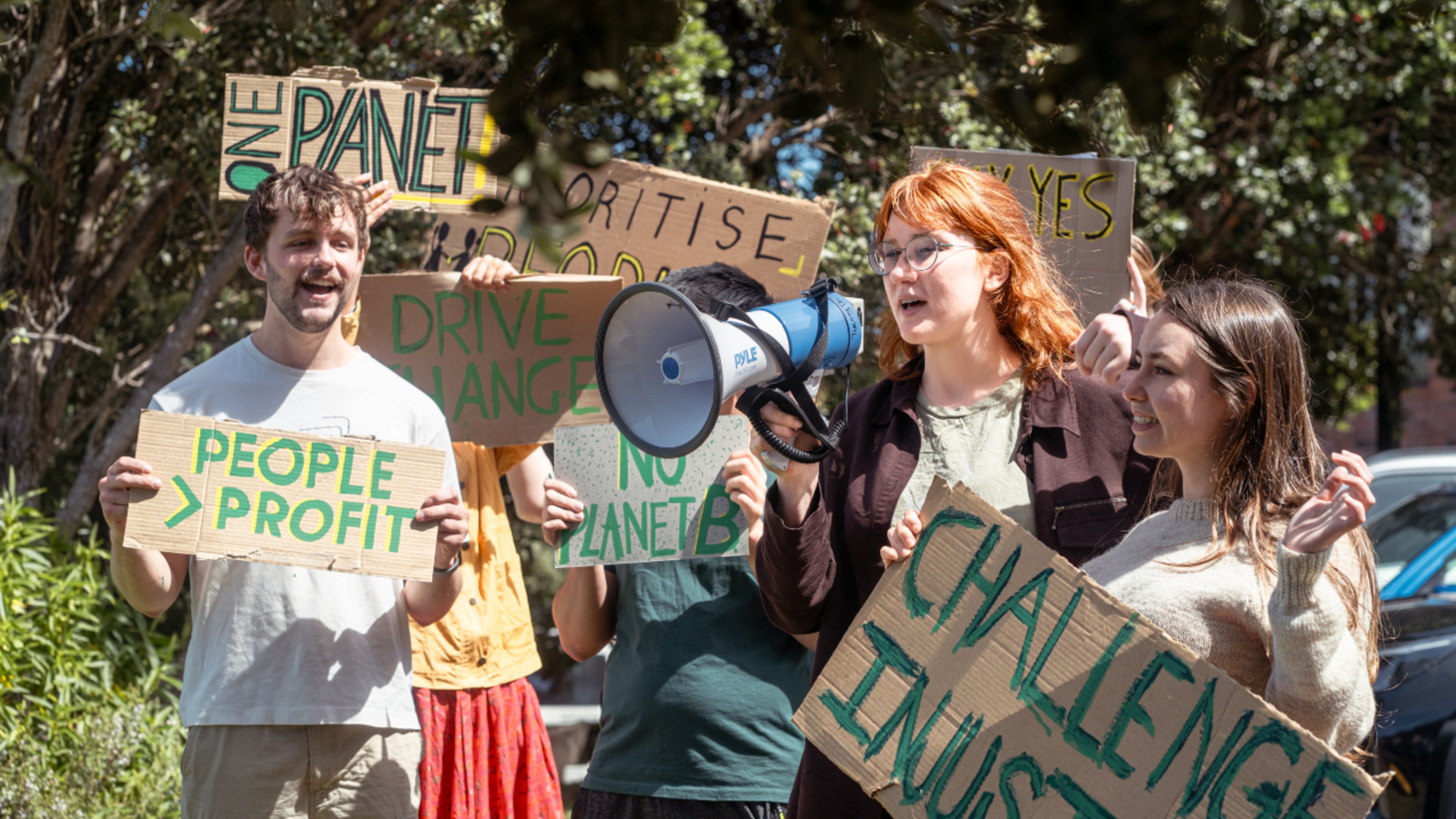
Shape stories that connect people to science
Society needs help accessing and understanding science—whether it’s the latest scientific breakthrough, a new climate change policy, or a global pandemic.
Build a specialised skillset to communicate scientific findings and advice, combining communication and technical expertise. Develop your scientific literacy. Learn ways to communicate science and its nuances—based on the message, method, audience, and goal. Explore the challenges of science communication.
Study Science Communication at the only university in Aotearoa New Zealand to offer this as a major. You’ll build the skills to inform the public, raise awareness, and influence attitudes and behaviours. You’ll also be able to advocate for change, address issues, or inform policy.
What you’ll learn
Develop communication skills
Learn science communication theory and techniques. Get hands-on experience designing science communication projects and events.
You’ll learn skills to communicate science to a range of audiences and age brackets through verbal, written, and visual communication forms, such as:
- informal education
- journalistic writing
- video
- podcasting
- interactive media.
Connect with experts
You’ll learn from lecturers who are well-connected in areas like science media and communication and science policy.
Hear from guest lecturers like:
- science journalists and writers
- media and communications advisers
- broadcasters
- podcasters
- science outreach, engagement, and education advisers.
Choose your study path
You can study Science Communication as a major or minor to combine your study with other subjects that interest you. You can pair Science Communication with another subject as a double major or a conjoint degree.
Combining your study with complementary science, humanities, or social science subjects can help you better understand different groups in society and their needs and experiences.
Science Communication can also be studied as a minor with a range of other degrees.
Science Communication major in the Bachelor of Science
If you major in Science Communication with a Bachelor of Science, you must also do either a minor or a second major in another science subject. This can be from the BSc, BBmedSc, or BPsyc—except the Science in Society minor.
Degree support and advice
We can help you match your interests and career goals with the right course of study.
If you’re a new student, talk to a Future Student Adviser.
If you’re already studying with us, talk to Tītoko—Student Success.

Study options
Find out how you can study Science Communication at Te Herenga Waka—Victoria University of Wellington.
Future careers
As a Science Communication graduate, you could work in roles such as:
- communications or media adviser
- policy adviser
- creative non-fiction or science writer
- event or campaign organiser
- education and outreach adviser.
More career information
Find out more about Science Communication roles, where you could work, and how to build skills or career connections in your specific area of study.
The government careers website, Tahatū, offers more information about jobs, salaries, and current opportunities.
Scholarships
You may be able to get a scholarship to help fund your studies.
We have first-year and school-leaver scholarships available, as well as specialised scholarships for different groups and subject areas. If nothing fits right now, something may suit you later.
We encourage you to apply. It’s a straightforward process, and it could make a real difference.
Scholarships for Science and Humanities
-
The Erasmus Scholarship is open to second year students at Te Herenga Waka—Victoria University of Wellington who want to major in Greek or Latin.
-
The scholarship is open to full time students enrolled in Mathematics or Physics, who are entering their second or subsequent year or postgraduate study at Te Herenga Waka— Victoria University of Wellington.
-
This scholarship is designed to support second year students studying English at Te Herenga Waka—Victoria University of Wellington by removing financial barriers to study.
Scholarships for international students
We are currently offering a NZ$15,000 VUW Undergraduate International Scholarship to all eligible international students enrolling in a Bachelor’s degree.
Your scholarship will be processed automatically when your programme application is accepted, and the amount will be deducted from your tuition fees.
Other scholarships
We also offer specialised scholarships for different groups and subject areas. If nothing fits right now, something may suit you later.
We encourage you to apply. It’s a straightforward process, and it could make a real difference.
Scholarships for Science and Humanities
-
The Erasmus Scholarship is open to second year students at Te Herenga Waka—Victoria University of Wellington who want to major in Greek or Latin.
-
This scholarship was established in 1980 by the former Prime Minister of New Zealand, the Rt. Hon. Sir John Marshall, GBE, CH, BA, LLM, Hon. LLD, to encourage the study of Political Science at Te Herenga Waka - Victoria University of Wellington. The Scholarship was extended to include International Relations.
-
This scholarship was established to encourage students to complete a major in Language Sciences at Te Herenga Waka - Victoria University of Wellington, and continue to further study or careers in this field.
Globally ranked
Our Communications and Media Studies subjects are ranked in the top 250 worldwide in the QS World University Rankings 2026.
The QS World University Rankings is an annual global publication that gives overall rankings and subject rankings for more than 1,500 universities worldwide.
Postgraduate study
Continue your study with a postgraduate qualification to further explore Science Communication and increase your career options.
You could study for the:
If you’re looking to add to your current qualifications, seeking professional development for your current role, or you’re not ready to commit to a full Master’s programme, a Postgraduate Certificate or Diploma may suit you better.

Get help to manage your finances
We can help you:
- budget your money
- manage your student loan or allowance
- work out your accommodation payment schedule.
If you're facing financial difficulties, we can help you apply for the Hardship Fund.
You may be eligible for government or community support, too.


Wellington Global Exchange
If you're a current student at Victoria University of Wellington, you can complete part of your degree overseas. Choose from our 140 partner universities worldwide.

Study Abroad and Exchange Programme
If you're an overseas student, you can spend a trimester or a year at Victoria University of Wellington. You'll earn credits at your home university while you study here.